Corruption and International Treaty Developments in Asia

Written by: Luke Nottage (University of Sydney) and Nobumichi Teramura (Universiti Brunei Darussalam)

[Ed. Note: Our related new book (open access through Springer) was launched by the Attorney-General of Brunei at a symposium held there on 28 May 2024 (as reported here). A follow-up seminar and local re-launch by former Chief Justice of Western Australia Wayne Martin (pictured below with other book contributors/speakers), including some new research emerging from the book, was held at USydney Law School on 1 August (further details here, with Nobu Teramura’s presentation/overview Powerpoints also for LSA conference presentation here). Many thanks to all involved in this book project, including for funding from the Centre for Asia-Pacific Law at the University of Sydney (CAPLUS), Universiti Brunei Darussalam, and the University of Wollongong’s Transnational Law and Policy Centre.

A version of the Blog posting below, re-titled “Corruption Control Needs a Clean-Up in Asia”, was published on 18 July 2024 by the East Asia Forum – thanks to their editors and an anonymous reviewer.]

Corruption remains a serious problem in most parts of Asia. The economic effects are serious, regionally and globally, and the COVID-19 pandemic sometimes made the situation worse. Emergency measures for government procurement and management of the economy expanded opportunities for graft and impacted adversely on enforcement activities.

This problem has persisted for many years despite many new legal instruments aimed at or potentially impacting on corruption, as explored also in our recent book (open-access, so PDFs freely downloadable).

First, the OECD Convention (signed from 1997), prompted by the US enacting the Foreign Corrupt Officials Act two decades earlier, focused on the ‘supply side’. Developed economy member states (including Japan and Korea in Asia) committed to criminalising at home the bribery of foreign officials. Secondly, the UN Convention (signed from 2005, by almost all Asian states) covered bribery of both domestic and foreign officials, including also the ‘demand side’ (solicitation and receiving bribes).

However, the commitments under these multilateral treaties are often quite general, not setting for example any minimum criminal penalties for bribery. As Anselmo Reyes elaborates in his co-authored chapter, both treaties also leave open the possibility of allowing ‘facilitation payments’ – smaller ‘grease money’ payments to expedite routine government transactions like permits. Canada disallowed these under 2017 legislation but Australia’s 2024 amendments retain this possibility – perhaps reflecting the arguments of some economists (investigated in our book by Ahmed M Khalid, Bruno Jetin and others with econometric studies) that such low-level bribery in fact may be efficient.

In addition, even for the core commitments under both treaties, there is not much incentive for transparent and effective enforcement by member states. This is especially true in developing economies with less media freedom and/or democratic accountability – also under pressure. Scrutiny of enforcement under these treaties relies mainly on ‘peer review’ mechanisms that take years to implement, and recommendations on member states for improvements are not binding.

Some states have created new anti-corruption agencies and even courts, as in Indonesia and Thailand, but have faced political backlash. Others, like Vietnam and China, have sometimes vigorously enforced anti-corruption laws (including through the death penalty), but some suspect this is done selectively for political purposes.

A few Asia-Pacific states (such as Thailand and now in Australia) have followed the lead of the UK’s Anti-Bribery Act 2010, which specifically sanctions firms that do not take reasonable measures to introduce anti-bribery compliance schemes. This makes mandatory a feature of the opt-in UN Global Compact scheme that (larger) companies have started to sign up to. They may anyway be conscious of pressures from investors influenced by environmental, social and governance (ESG) considerations.

This slow and sporadic transition towards taking corruption more seriously is also evident in provisions found in free trade agreements (FTAs) entered into by developed countries and regions: the EU, the US, Canada and (notably in Asia) Japan. These treaties also commit member states to both enact and enforce anti-bribery laws. They are reflected in some ‘mega-regional’ FTAs like the Regional Comprehensive Economic Partnership (Chapter 17) and in more detail the Comprehensive and Progressive Agreement for Trans-Pacific Partnership (Chapter 26), but curiously not in the recently signed Second Protocol to the ASEAN Australia New Zealand FTA (except regarding government procurement: Chapter 17).

Typically, however, these treaties too are broadly worded, and corruption-related enforcement issues are not subject to their inter-state dispute settlement provisions that help make the commitments more credible. This limitation also seems to apply to the new  WTO Investment Facilitation Agreement (although its text is not yet public).

Corruption issues have been cropping up also increasingly, especially from around 2010, in investor-state dispute settlement (ISDS) arbitrations initiated under FTA investment chapters or standalone bilateral investment treaties (BITs). Occasionally under such international investment agreements (IIAs), a foreign investor claims compensation because host state officials solicited a bribe in contravention of the ‘fair and equitable treatment’ commitment under the IIA.

More often, the host state raises as a defence against an ISDS claim that the allegation that the foreign investor made a bribe when making the investment, so it is not covered under the IIA. If the arbitral tribunal agrees, it may decline jurisdiction, so the investor loses all treaty rights under international investment law and is left to the vagaries of host state law and court procedures. This typically arises where the IIA specifies expressly that it only covers investments made ‘in accordance with host state law’. Such outcomes may indeed incentivise foreign investors to avoid any form of bribery.

However, what evidence will prove such bribery, especially given that arbitrators (unlike anti-corruption agencies or courts) lack powers vis-à-vis third parties (like banks)? What if the alleged corruption is minor, vigorously solicited by public officials, commonplace and/or systemic in the host state? And what if it leads to the perverse incentive of the host state deliberately seeking a bribe, never enforcing sanctions against the official, but keeping evidence of the bribe as a ‘get out of jail free card’ if ever the foreign investor brings an ISDS claim after the host state discriminates or otherwise violates substantive commitments given under the IIA to encourage inbound investment? Focusing on East and South Asia, we and other authors in our book focus on possible more nuanced solutions for such scenarios, under existing or revised IIAs.

Overall, addressing corruption requires a careful assessment of its various manifestations, some much worse than others (as argued for China, for example). But it should also carefully consider the procedural mechanisms under both national law and international treaty law that help ensure appropriate enforcement of substantive commitments made by states.

Australia’s Anti-ISDS Approach Again: AANZFTA Protocol To Be Ratified

Around 21 May 2024, after I had presented a submission and oral evidence at a public hearing late March, the Australian Parliament’s Joint Standing Committee on Treaties (JSCOT) issued its Report 215 agreeing that the Australian government should proceed to ratify the ASEAN Australia NZ Agreement for a Free Trade Area (AANZFTA) Second Protocol. This is despite the Labor Government in November 2022 declaring that it will not agree to any form of investor-state dispute settlement (ISDS), relevantly arbitration, in future treaties; and will approach counterparties seeking to remove or otherwise revise ISDS provisions under existing treaties. The Protocol includes a Work Program to review the ISDS provisions, within 18 months of coming into force, which will proceed largely in parallel to a review of the investment chapter also in the Regional Comprehensive Economic Partnership (RCEP) FTA, which might involve adding ISDS provisions, as it includes the same 12 states party but also three big FDI exporting economies that have generally favoured ISDS: Japan, Korea and China.

In the JSCOT inquiry into ratifying the AANZFTA Second Protocol, the Australian Council of Trade Unions (ACTU) and a small NGO (the Australian Fair Trade and Investment Network, AFTINET, which has persistently objected to ISDS in IIAs in parliamentary inquiries) recommended against ratification due to the Second Protocol retaining ISDS for at least the next few years. My Submission recommended ratification, explaining some of the context for ISDS (along the lines and other cited writings mentioned above) and appending my 2020 Submission to DFAT’s review of old IIAs (reiterating where the Second Protocol’s work programme might make some further drafting improvements around ISDS, especially to further enhance transparency and efficiency). We three were then invited to give (concurrently) oral evidence to JSCOT on 25 March 2023.[1]

The ACTU and AFTINET presented a very broad (and curiously similar) definition of ISDS:  a procedure giving corporations additional rights to sue governments for compensation if they can argue a change in law or policy will harm or impinge on their future profits. They also both highlighted the three claims recently brought under AANZFTA against Australia by Zeph (a Singapore-incorporated company controlled by Australian mining magnate and politician Clive Palmer) and more generally the risks of regulatory chill to sovereign states particularly from fossil fuel investors, as well as the costs of defending claims even when states prevail. (Similar arguments were presented in the Open Letter from Australian academics and lawyers opposing ISDS, circulating from May 2024.[2]) AFTINET also asserted that there was no good evidence that ISDS-backed IIAs promoted FDI flows and that recent IIAs were omitting ISDS – including supposedly for India and New Zealand, but also the EU and Brazil.

My own evidence countered that ISDS claims require additionally proof of violation of substantive commitments offered by host states, that the Zeph claims face difficulties and anyway Australia does not close down its courts due to occasional aggressive litigants, while its outbound investors also protect their investments abroad through ISDS claims – particularly against states with governance issues. I also reiterated that there is some evidence ISDS-backed IIAs promote cross-border FDI, developing economies are failing to attract sufficient FDI to support the global energy transition,[3] and many states (including also eg Indonesia, India and Vietnam) are still offering ISDS in IIAs despite experiencing some inbound claims.


[1] The transcript of this Evidence is at ‘Second Protocol to Amend the Agreement Establishing the ASEAN-Australia-New Zealand Free Trade Area (ANAZFTA) Public Hearings’, Parliament of Australia (Transcript) <https://www.aph.gov.au/Parliamentary_Business/Committees/Joint/Treaties/AANZFTASecondProtocol/Public_Hearings> and the video-recording is at https://www.aph.gov.au/News_and_Events/Watch_Read_Listen/ParlView/video/2299575.

[2] Open Letter on ISDS (May 2024) <https://docs.google.com/forms/d/e/1FAIpQLSddWDUB2NzZAHYlGJDOxg0DiA-JySOGEE7f_09ZdwQNhryr3g/viewform>.

[3] ‘World Investment Report 2023’, United Nations Conference on Trade and Development (Report) <https://unctad.org/publication/world-investment-report-2023>.

When JSCOT’s Report 215 was issued, contrary to my expectation and curiously as this departs from her party’s past practice where a treaty includes ISDS, the Greens Senator for Western Australia Dorinda Cox did not issue a dissenting report – nor even seemingly attend either parliamentary hearing. The Report’s summary emphasised that:[1]

“Notably, Australia successfully negotiated a review of the existing ISDS provisions in [… marking] an instalment of the Government’s commitment to review ISDS provisions in agreements where they already exist, while ensuring Australia does not agree to ISDS mechanisms in new agreements.”

The Report’s Conclusions added (after noting my call for transparency around this ongoing Work Program):[2]

“Considering the significant interest in this issue demonstrated by a range of stakeholders in this and previous JSCOT inquiries, the Committee will seek an update on the progress of the ISDS review work program commitment in due course, and in any case would expect the Department [of Foreign Affairs and Trade: DFAT] to draw any notable developments to the Committee’s attention.”

The Report also quoted evidence given by DFAT that it “will obviously be coming to government to seek a mandate for the positions that we take into that review’ of ISDS under the Work Program”.[3]

Interestingly, the Report did not specifically mention the Zeph claims, although it stated:[4]

“At the public hearing submitters to the inquiry pointed out that there are currently ISDS actions afoot, some of which involve arrangements between Australia and ASEAN nations. The Committee inquired as to the cost of these legal actions to the Australian taxpayer. The Attorney-General’s Department (AGD) said ‘the Attorney-General and the Prime Minister have instructed us to vigorously defend those matters and we are in the process of doing so, and that does accrue cost.

In addition, after recording the opposition to ISDS and hence treaty ratification from the ACTU and AFTINET, the Report noted my concerns about relying solely on more politicised inter-state dispute settlement or arbitration agreed under individual investment contracts, before observing:[5]

The Committee sought clarification as to the recent trend away from ISDS. Professor Nottage said, ‘I think that’s a good thing—that we try something; it has an effect; we realise some of its problems, so we try to fix the problems […] and come up with a new compromise solution’.

My quoted statement in fact followed more specifically from my observation about the question of a ‘retreat from the high water mark of pro-ISDS approaches’.[6] The Committee also did not go on to mention my point immediately following in evidence that the EU has not abandoned direct claims by foreign investors altogether, but come up instead with the investment court compromise. I had suggested that this model could be considered by Australia (and regional states) in future treaty practice even when not negotiating with the EU, for example in the ongoing review of ISDS under AANZFTA’s Second Protocol and RCEP. (Subsequently I developed this proposal in a letter dated 10 April to the Trade Ministers of Australia and New Zealand.)

Furthermore, the Report did not mention my written Submission urging again specific improvements, including restrictions on ‘double-hatting’ and compulsory mediation before arbitration.[7] Overall, therefore, it seems that parliamentary interest and scrutiny around the specifics of ISDS or possible alternatives remains quite limited, deferring largely to the executive branch of government.


[1] Report 215: AANZFTA Second Protocol, available at Parliament of Australia <https://www.aph.gov.au/Parliamentary_Business/Committees/Joint/Treaties/AANZFTASecondProtocol/Report>, xv.

[2] ibid, para 2.95 (and 2.79).

[3] Ibid, para 2.74.

[4] Ibid, para 2.75. This level of generality may reflect a compromise reached between the Labor and Greens members (who might have preferred to mention Zeph and Clive Palmer specifically) and the Coalition members in drafting the joint Report.

[5] Ibid, para 2.80.

[6] Idem.

[7] Available at Parliament of Australia, <https://www.aph.gov.au/Parliamentary_Business/Committees/Joint/Treaties/AANZFTASecondProtocol/Submissions>.

Compromise way forward on investment treaty/FTA (re)negotiations

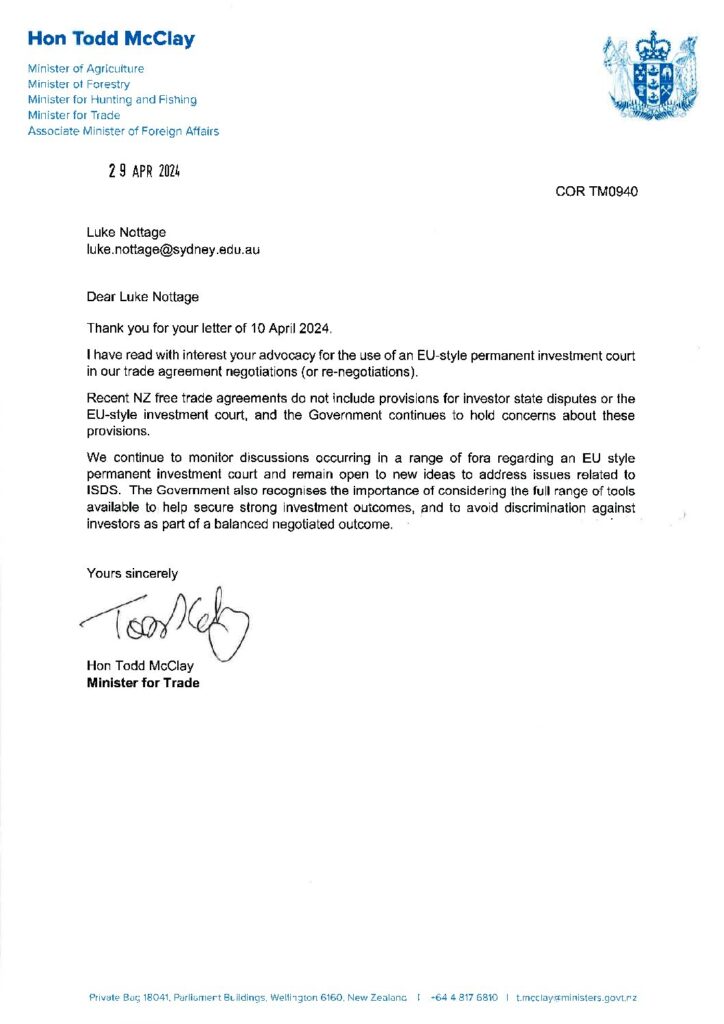
[On 10 April 2024, following my submission and then oral evidence given to the Australian parliament inquiring into the AANZFTA Second Protocol ratification, I wrote as follows to the respective Trade Ministers of Australia (Hon Don Farrell) and New Zealand (Hon Todd McClay). The latter’s response dated 29 April, quite non-committal, is below and here. I also had (confidential) discussions with DFAT officials on 23 May 2024 regarding my proposal.]

I am a New Zealander working in Australia since 2001, specialising in international business law including international and domestic investment law and dispute resolution.[1] I have provided many submissions to Australian parliamentary inquiries into ratifications of bilateral investment treaties or investment chapters of Free Trade Agreements (FTAs), including giving related evidence on 28 March 2024 urging ratification of the Second Protocol to the (ASEAN+2) AANZFTA.[2] Representatives from the Australian Council of Trade Unions and AFTINET (Australian Fair Trade and Investment Network) opposed ratification of the Protocol especially as it retained investor-state dispute settlement (ISDS) provisions, albeit to be revisited in a Work Program. The latter will run largely in parallel to negotiations to consider instead adding ISDS to the ASEAN+5 Regional Comprehensive Economic Partnership (RCEP), which FTA also involves Australia and New Zealand.

Australia’s Labor Government from November 2022 has reverted to its stance, when in power over 2011-13, to opposing ISDS in new treaties, but seemingly does not extend this position to protocols to existing treaties like AANZFTA. The Labor Government also will approach counterparty states to review past treaties. Until losing the general election in October 2023, New Zealand’s Labor Government from 2018 had similarly opposed ISDS in new treaties. However, the new Coalition Government may revert to a more flexible approach towards ISDS provisions.

As a compromise way forward for both countries, with significantly shared economic and geopolitical interests, I proposed in the AANZFTA parliamentary inquiry that in that FTA’s Work Program as well as the parallel RCEP (re)negotiations concerning ISDS, serious consideration be given to substituting an EU-style “permanent investment court” hybrid form of dispute resolution to underpin the substantive commitments (like non-discrimination and fair and equitable treatment) offered in such treaties. Unlike ISDS, the foreign investor complainant does not nominate an arbitrator. Instead, the investor’s home state and the host state counterparty select in advance a panel of “judges”, who are then selected to decide the claim (albeit following arbitration rules and issuing awards). The model also provides for a second-tier review, by other adjudicators selected from the panel, for any serious error of law or fact. Such features make this investment court model sufficiently different from ISDS, in my view, to not conflict with the anti-ISDS policy of the current Australia’s Labor Government or the previous New Zealand Labour Government. Yet it still allows for foreign investors to initiate a claim, without having to lobby its home state to press for initiation of an inter-state arbitration. The latter mechanism is also provided in investment treaties, but is rarely used where the more direct ISDS route is available and is much more subject to (geo-)political vagaries – as we observe also with WTO inter-state adjudication.

Further, this compromise investment court model was developed in the EU almost a decade ago after extensive consultation with legal experts and other stakeholders there, and it has since been accepted in FTAs notably concluded by Canada, Singapore and Vietnam.[3] The model is also promoted by the EU in ongoing UN deliberations on reforming ISDS multilaterally. It is in the EU’s negotiating mandate for the FTA being negotiated with Australia, and if it is not accepted then that FTA unfortunately will not include provisions on investment protection (only instead on preferential market access for agreed investments, underpinned solely by inter-state arbitration). That was also the outcome in the FTA between the EU and Japan, which preferred to retain instead ISDS-backed protections for its investors into many individual EU states under older treaties. The New Zealand-EU FTA similarly does not include any provisions on investment protection, yet New Zealand’s outbound investors lack such BITs with individual EU member states. New Zealand’s new Coalition Government might now consider adding a protocol on investment protection, agreeing after all with the EU’s court mechanism, to encourage more cross-border investment flows.

Greater consideration by both New Zealand and Australia to the investment court model would also be useful as each continues to negotiate FTAs with the other non-EU counterparties, including across Asia (such as the Australia-India negotiations to conclude a treaty going beyond trade in goods). It would also open up space for greater bipartisanship with each country and therefore speed up FTA negotiations.

In fact, in late 2017 I wrote to your respective predecessors as Trade Minister with Dr Amokura Kawharu (then a professor at University of Auckland, now President of the New Zealand Law Commission). Drawing on recent research (which I have updated[4]), we urged even then Australia and New Zealand to consider the EU-style investment court model and coordinate more in progressing investment treaty negotiations, including for RCEP.[5] That FTA could then have been more easily and quickly agreed upon, and indeed included India which in 2019 withdrew from negotiations. Closer joint consideration of the investment court model deserves renewed attention from both Australian and New Zealand governments, as they look to (re)negotiate various investment treaties, including still AANZFTA. The investment court model may not be perfect but nothing ever is, and it promises a better way forward than the current flip-flops in each country around traditional ISDS.

I would be happy to confer with you or relevant staff to discuss this further, or provide additional information.

Yours sincerely

Luke R Nottage


[1] Profile and CV at https://www.sydney.edu.au/law/about/our-people/academic-staff/luke-nottage.html. My father (Richard Nottage) was former Secretary of Foreign Affairs in New Zealand and my brother (Hunter) was later Senior Trade Law Advisor with MFAT.

[2] See transcript and Submission via https://www.aph.gov.au/Parliamentary_Business/Committees/Joint/Treaties/AANZFTASecondProtocol

[3] For details see eg Moritz Keller (ed) EU Investment Protection Law: Article-by-Article Commentary (Beck/Hart, 2023).

[4] See eg, on the evolving studies on the impact of ISDS provisions on cross-border FDI, my submission in 2020 to DFAT’s review of Australia’s bilateral investment treaties (available at https://www.dfat.gov.au/trade-and-investment/discussion-paper-review-australias-bilateral-investment-treaties), summarised eg in my chapter “Rebalancing Investment Treaties and Arbitration in the Asian Region”, in Mahdev Mohan and Chester Brown (eds) The Asian Turn in International Investment(Cambridge University Press, 2021) 379-398.

[5] Our 2017 letters can be found at https://japaneselaw.sydney.edu.au/wp-content/uploads/2017/11/2017KawharuNottageTurnbullGovt_Combined_LN01.pdf, via https://japaneselaw.sydney.edu.au/2017/11/nz-renounces-isds-deja-vu/

Australia’s Anti-ISDS Approach Again: AANZFTA Protocol Ratification Hearing in Parliament

On 21 August 2023 Australia signed, with New Zealand and the ten member states of the Association of Southeast Asian Nations (ASEAN), the Second Protocol to Amend the Agreement Establishing the ASEAN-Australia-New Zealand Free Trade Area (AANZFTA), after announcing in November 2022 substantial conclusion of the free trade agreement (FTA) review that had commenced in September 2018. This amended treaty added new chapters and updated many others, whereas the first Protocol in 2015 focused on streamlining certification for cross-border movement of goods.

For example, as I noted in my written Submission in January 2024 to the Australian Parliament’s Joint Standing Committee on Treaties (JSCOT) inquiry into ratifying the Second Protocol, it added more provisions on consumer protection generally (in Article 7 of Chapter 17, but setting narrow minimum standards for national laws and not subject even to the inter-state dispute settlement Chapter that could help give those commitments more bite, compared to the Australia-UK FTA signed in 2021) and for e-commerce (Article 18 of Chapter 10, underpinned by inter-state dispute settlement – unlike the ASEAN+5 Regional Comprehensive Economic Partnership or RCEP signed in 2020).

However, my Submission and others focused mainly on the Second Protocol’s update to Chapter 11 on Investment. The substantive commitments (in Section A, Arts 1-18) were adjusted largely in line with RCEP’s Investment Chapter, but the main controversy concerned Section B’s retention of the investor-state dispute settlement (ISDS) option allowing arbitration as with the original AANZFTA (in forced from 2010). A week before the Second Protocol was substantially agreed, Australia’s Labor Government had declared on 14 November 2022 that it would not agree to ISDS protections for foreign investors in any future treaties, and would seek to review and remove them in past investment treaties. The New Zealand government had also announced in late 2017 that it would not agree to ISDS in future treaties, mimicking the stance of an earlier Labor (with Greens) Government when in power in Australia over 2011-2013.

Compromises were made when retaining ISDS in the Second Protocol’s Investment Chapter. The parties will first suspend application of the National Treatment commitment (not to discriminate against foreign investors compared to local investors, subject to scheduled country-specific exceptions) for breaches arising within 30 months of the upgrade. This is quite significant as the Second Protocol enlivens a previously inactive (Article 3) obligation for National Treatment. The second compromise is Article 17, providing for a work program to review Section B on ISDS no later than 18 months after the date of entry into force of the Second Protocol, to be concluded within 12 months unless extended by the states party – so probably by the end of 2027. (The program also requires discussion about adding two extra prohibitions of performance requirements in Article 6.1.) Given the Australian Labor Government’s opposition to ISDS, it can be expected to press for the removal or otherwise significant curtailing of Section B on ISDS. However, it faces a general election by May 2025, and if it loses to the Coalition the latter will reinstate a more flexible approach – agreeing to ISDS on a treaty-by-treaty assessment of Australia’s national interests. New Zealand’s Labor Government also lost the general election in October 2023, and its new Coalition Government is also likely to be quite sanguine about retaining ISDS.

In parallel, RCEP’s investment chapter had instead omitted ISDS but Article 10.18 established a work program to reconsider whether or not and how to add ISDS. This negotiation was to be started within two years of this ASEAN+5 treaty coming into force (January 2022 for ten states), to be concluded then within three years – so by the end of 2025. The largest non-ASEAN member states of RCEP with large outbound investments such as Japan, Korea and even China, may press for adding ISDS. However, their outbound investors mostly have anyway at least one other ISDS-backed treaty to invoke even without RCEP (eg Japan and Australia have the CPTPP, even though ISDS was omitted also from their 2014 bilateral FTA).

My Submission, and oral evidence given (with video-recording here) in favour of ratifying the Second Protocol (contrasting with the evidence and submissions opposing ratification from the Australian Council of Trade Unions and AFTINET), identified likely net benefits from ISDS-backed treaties including this one but also options for further drafting improvements, drawing partly on my submission to the 2020 DFAT review of Australia’s standalone bilateral investment treaties. I also urged ongoing transparency and stakeholder involvement in the envisaged work program.

We can expect most JSCOT members to recommend that Australia ratifies the Second Protocol. After all, JSCOT always has a majority of Government parliamentarians on the Committee, and its own minister has already signed the Protocol (after review by Cabinet colleagues). In addition, the Coalition parliamentarians in opposition have always maintained a flexible approach towards ISDS provisions. The solitary Australian Greens member, however, seems likely to recommend against ratification, as its parliamentarians have done on committees considering treaties that contain ISDS provisions. What will be more interesting is what the Labor members say about ISDS, including the evidence given, and what that might imply for Australia’s ongoing negotiations regarding investment agreements with India and the European Union.

Cross-Fertilisation in International Commercial Arbitration, Investor-State Arbitration and Mediation: The Good, the Bad and the Ugly?

[This is the title of the 6th Annual ADR Address for the Supreme Court of New South Wales, co-organised by the Australian Disputes Centre. It was orginally to be presented on 2 November 2023 but my e-bike accident meant deferring it until 22 February 2024! The public lecture includes several comparisons to developments in Japan and other Asian countries. Registration and other information regarding this lecture event, including the forthcoming paper, are available via https://disputescentre.com.au/events/supreme-court-of-new-south-wales-adr-address-2023/. The Introduction is reproduced below, a few more details are published on 12 February 2024 via the Kluwer Arbitration Blog, and my draft Powerpoints for the public Address are here. Past presenters and topics were:

2018 – Chief Justice Tom Bathurst –“ADR, ODR and AI-DR or, Do We Even Need Courts Anymore?”

2019 – Her Excellency the Hon. Margaret Beazely AO KC – “Conflicts of Interest in Commercial Arbitration”

2020 – The Hon. Justice Andrew Bell – “The Rise of the Anti-Arbitration Injunction”

2021 – The Hon. Justice Julie Ward – “Online Dispute Resolution in the Age Covid-19”

2022 – The Hon. Robert French AC – “ADR and the Elusive Butterfly of Social Justice”

I thank Chief Justice Bell and the Supreme Court of New South Wales for hosting this event, and Deborah Lockhart and her team at the Australian Disputes Centre for organising this Annual ADR Address. I particularly appreciate their flexibility in deferring the presentation date after my e-bike accident late last year, and for everyone’s attendance today instead. I acknowledge the Gadigal People of the Eora Nation as the traditional custodians of this land, along with their elders. I also acknowledge the elders from the judiciary who have presented the past five Annual Addresses, which I refer to in my paper soon available via the ADC webpage, and I am grateful for other information and feedback on earlier drafts from them and several others. As my paper is now too long to present verbatim, and Alternative Dispute Resolution is all about flexibility, I will mainly present this Address around these Powerpoint slides (also available in draft via my University of Sydney blog).

  1. Introduction

International arbitration (IA) has burgeoned especially since the 1990s, including across the Asian region (as elaborated below in Part 2). The growth originated in international commercial arbitration (ICA), but it has been bolstered especially over the last 10-15 years from mostly now treaty-based investor-state arbitration (ISA). However, as in the 1990s, concerns are again building about escalating delays and especially costs (Part 3). This is due not just to the growing complexity of transactions and therefore disputes. Other factors contributing to costs and delays arguably include IA still having no real competitors for cross-border dispute resolution, the growth of large law firms and the billable hours culture, conservatism about controlling legal costs (eg via caps on fees or sealed offers), the double-edged sword of confidentiality, and the proliferation of soft law instruments. 

There has been quite extensive discussion in case law and commentaries about the relationship between ICA and international litigation conducted through courts, as part of an overall system for resolving cross-border commercial disputes.[1] The present paper takes an even more encompassing view. It teases out some connections or influences among ICA, ISA, international and domestic mediation, which may be or become more or less productive, particularly from the perspective of reducing costs and delays.

Cross-fertilisation from mediation practice has not yet borne much fruit globally in the form of hybrid Arb-Med, where parties authorise arbitrators themselves to act as mediators (Part 4), in ISA and even in ICA. Instead, Med-Arb and other multi-tiered dispute resolution clauses (involving separate neutrals) are becoming more prevalent in cross-border transactions, aiming to reduce the costs and delays associated with proceeding to IA (Part 5). However, the spread has not been uniform across the world of ICA, and has not yet impacted much on investment treaties and therefore ISA. In addition, cross-fertilisation partly from ISA regarding the consequences of non-compliance with pre-arbitration steps in such clauses is causing complications, although it may lead to constructive solutions in ICA as well as ISA. Overall, various cross-overs are already evident among ICA, ISA and international mediation, and such cross-fertilisation needs to be tracked and channelled into the most productive interactions.


[1] See, eg, Michael Hwang, ‘Commercial Courts and International Arbitration—Competitors or Partners?’ (2015) 31(2) Arbitration International 193; James Allsop and Samuel Walpole, ‘International Commercial Dispute Resolution as a System’ in Sundaresh Menon and Anselmo Reyes (eds) Transnational Commercial Disputes in an Age of Anti-Globalism and Pandemic (Hart 2022) 43; Franco Ferrari and Friedrich Rosenfeld, ‘Deference in International Commercial Arbitration: Setting the Stage’ in Franco Ferrari and Friedrich Rosenfeld (eds), Deference in International Commercial Arbitration (Wolters Kluwer, 2023) 3.

“The Vis Moot in Japan: Tips and Tricks for Participants”

This hybrid-format 14 February 2024 seminar in Tokyo was planned primarily by the “Japan Arbitration Club” formed recently among younger arbitration experts and afficionados, led by Carlotta Bruessel (now with Nishimura & Asahi, Japan’s largest law firm, and previously working in Canberra and Sydney) who also moderated this seminar. My co-panellists included Eriko Kadota, now a managing associate in Tokyo with Linklaters (which co-sponsored the seminar and provided the venue) who competed successfully for ANJeL’s “Team Australia” in the intercollegiate negotiation and arbitration moot competition (INC) while a student at Sydney Law School. Other event supporters were the Australian Network for Japanese Law (ANJeL), the International Chamber of Commerce’s Young Arbitration and ADR Forum (ICC-YAAF, as this year’s Vis Moot applies the ICC Arbitration Rules) and the Moot Alumni Association for the Vis moot. The latter’s Japan members and others have started coordinating a “pre-moot” competition for Japanese university teams before they go to the main Vis Moot held in Vienna or the spin-off Vis East Moot held in Hong Kong.

The main focus of this seminar was to share experiences and ideas especially for Japanese students and coaches about what to expect in the Vis Moots. However, to that end I added some contrasts with the INC, which has also greatly enhanced interest and skills in arbitration among Japanese and other law students over the last two decades.

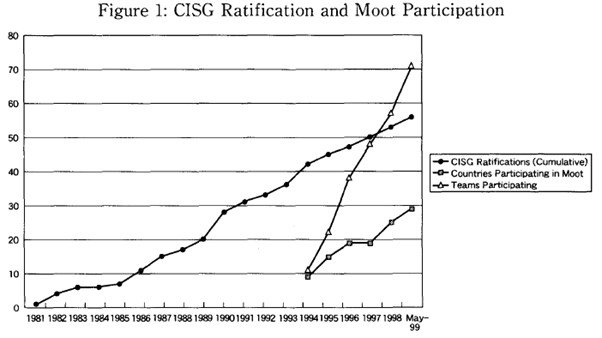
My first encounters with the Vis Moot dated back to the late 1990s, when I was joined as associate professor at Kyushu University Law Faculty by Hiroo Sono, who had already attended the Vis Moot and eventually became Dean of the Law School at Hokkaido University. (We also ended up co-authoring in 2019 a Kluwer book on Contract Law in Japan.) I took his prescient advice to attend the Sixth Vis Moot in Vienna as a mock arbitrator around Easter in 1999, as he had done in 1997. Then we ran a small courses for the Japanese-language LLM program and then new English-language LLM/LLD program in Kyushu University to coach a team that competed in the Seventh Vis Moot in Vienna in early 2000. Already there had been one Japanese team, from Meiji Gakuin University (competing in the Fifth and Sixth Vis Moots), but there was very little awareness of the competition around that time – or indeed about arbitration – in Japan. Writing articles in Japanese (in 1186 Jurisuto and 67 Hosei Kenkyu / Journal of Law and Politics, in 2000) with Professor Sono and in English (66 Hosei Kenkyu Part I and Part II in 1999) to promote more interest in the Vis Moot, I speculated that its growth already over the 1990s was linked partly to states starting to accede to the UN Sales Convention (CISG, agreed in 1980 and in force from 1988). It was even clearer that the numbers of teams per country were rising, generating critical mass and even by then creating scope for “pre-moots” before the main competition in Vienna – as seen from this Figure 1 reproduced Part II of my 1999 article in Hosei Kenkyu:

Japan acceded in 2008 (as explained in his JJL article here), thanks significantly to the efforts of Professor Sono who was seconded around then to the Ministry of Justice from Hokkaido University to promote understanding and engagement with CISG. This has made the UN Sales Convention directly relevant for Japanese traders and their legal advisors, who also need to assist Japanese subsidiaries and affiliates especially in Asian states that are also increasingly member states of CISG. Another contemporaneous development has been the comparatively belated but (especially since 2017) significantly greater interest in international arbitration among stakeholders in Japan (including now some very large local law firms, as well as branches of Western firms that were allowed full profit-sharing partnerships with Japanese bengoshi lawyers from 2004). This evolving context helps explain why by the 30th Vis Moot in Vienna held in 2023, there were four teams from Japanese universities (out of by then 380 teams in total): Doshisha, Kwansei Gakuin, Waseda and Seinan Gakuin. And for the 20th Vis East Moot in 2023, for example, Nagoya University reached the final eight teams.

These are impressive achievements for teams coming from a country where the native language is not English (the language of the Vis Moots), which helps Australian and other university teams; and not even a Western language, which helps continental European and other teams that have also been frequent and often very successful competitors as well. A further challenge for Japanese teams has been that traditionally the law schools from common law jurisdictions put more emphasis on mooting generally, to build up the oral advocacy skills needed for the court cases that drove the development of the common law. (Already in 1999 I was impressed by the enthusiasm and skills of a team from an Indian law schools, which are also now often top performers in both Vienna and Hong Kong moots.) However, more opportunities for mooting and oral argumentation have grown also within the civil law tradition countries, including Japan – perhaps linked to its postgraduate Law School program inaugurated from 2004, which (with some difficulties) has expanded the numbers and skills of bengoshi lawyers. This gradual transformation in Japanese legal education more generally is arguably also reflected in the growing popularity and skill levels associated with the INC moot held in Tokyo towards the end of each year since 2002.

However, the INC moot differs in several ways from the Vis Moot, so the latter creates extra challenges for Japanese university teams – most of which compete now in both competitions. First, INC has a division or track where (sub)teams compete in Japanese, not just in English, and indeed the aggregate score for each university is reduced if competing only in one of the two languages. More preparations – in research, writing memorandums and the crucial practice moots – can therefore be done in Japanese as a native language. Japanese university teams competing only in English in the Vis Moots therefore need to factor in extra time and confidence-building exercises, perhaps involving more English-speakers as team members and coaches.

Secondly, the INC applies the UNIDROIT Principles of International Commercial Coontracts (first issued in 2004). Although their provisions overlap with CISG considerably, as later and opt-in rules of law (that parties must actively adopt), the UNIDROIT Principles can be more ambitious in their scope. They include provisions, say on regulating contractual unfairness, or allowing for adjustment of contracts in the event of supervening hardship, that are mostly left out of CISG for the applicable national law. The UNIDROIT Principles additionally apply to more complex (services and other) contracts than the international sale of goods, allowing for more arguments emphasising good faith and cooperation among the contracting parties than under CISG. In addition, the UNIDROIT as a restatement of the lex mercatoria are still not accepted by courts in many jurisdictions as governing law even if agreed upon by the parties for their cross-border contracts, unless combined with an international arbitration clause. And because arbitration is mostly confidential, whereas court litigation is mostly public, this means there is now much more publically-available case law on CISG from national courts around the world (and therefore related commentary) than on the UNIDROIT Principles as applied by arbitral tribunals.

The result of these differences is that arguments on contract law applying CISG in the Vis Moot tend to be more neo-classical and based on formal reasoning centred on the parties’ agreement and language used. By contrast, the arguments applying the UNIDROIT Principles in the INC moot can be more open-textured, appealing to wider contextual (moral, economic and other) considerations, although over the last decade or so these arguments have also become more formalised.

Thirdly, the INC is a one-shot competition. Each university only argues once in the arbitration round (and indeed only for one side, as assigned randomly by the organisers), even if the university fields multiple sub-teams competing in parallel. By contrast, the Vis Moot envisages that the higher-scoring teams can progress through to Finals, over many days of mock arbitration hearings. This also makes that competition more amenable to detailed and therefore more formal-reasoning arguments by the teams.

Fourthly, the INC traditionally did not address arbitration law problems, whereas those are often at least as important in the Vis Moot as the contract law problems. Recently, the INC incorporate some arbitration law questions in that round, but a key difference remains that the second day of the INC competition is a mock commercial negotiation seeking to reach agreement on a complex international joint venture. The skills required for successful negotiation, such as asking open-ended questions to try to understand the other side’s underlying interests, are often quite different that the more adversarial advocacy skills expected in international arbitration. Developing the latter is another challenge for Japanese university teams, even if students or coaches have become familiar with the INC moot.

Overall, the Vis Moot is designed to run as a quite formalised procedure, and has become more so as the numbers of teams competing in that competition has continued to grow. (This is true even of the Vis Moot East event, which I attended also in its earlier years when it was still smaller and therefore more like the Vienna moot over the 1990s.) This reflects the fact that the Vis Moots (in Vienna and to a growing extent also in Hong Kong) are also now a premier competition for students, coaches and mock arbitrators to network in order to enhance opportunities to actually practice international arbitration. There has also been resurgent formalisation of international arbitration over the last 10-15 years, including burgeoning costs and delays. Accordingly, Japanese participants in the Vis Moots should not be surprised to find that competition to be more rule-bound and intense even compared to moots like the INC.

Lastly, I share with you some excellent practical tips especially on oral advocacy for the Vis Moot (but also useful for the INC moot), from my colleague Prof Chester Brown. He has been lead coach for the University of Sydney Law School team that has competed very successfully in Vienna for around the last 15 years:

  1. Present clear and simplified arguments
  2. Signpost them (eg “We have three points …[but due to time the main focus will be on … unless the tribunal has particular interest in …]”)
  3. If “respondent” on issues, respond to points made by claimants rather than reverting to written submissions
  4. identify for the tribunal where parties agree or disagree (eg on the legal test)
  5. use evidentiary record and precisely
  6. remember points given for teamwork (eg for keeping to time)
  7. remember one’s own timekeeping (eg if arbitrator questions a lot on an early issue, be ready to present on the second issue in say 1-2 not 6-7 minutes (& then ask for extra minute for both sides).

ANJeL “Team Australia” 2nd again in INC Negotiation & Arbitration Moot!

Congratulations to University of Sydney Law School LLB and JD students Michelle Chen Daniel Hu, Kim Nguyen and Sean Yalcinkaya. They combined with other students mostly from ANU to form “Team Australia”, which again came second in the INC negotiation  and arbitration competition held over 9-10 December 2023 in Japan (this time pipped by UTokyo, with KyotoU coming third).

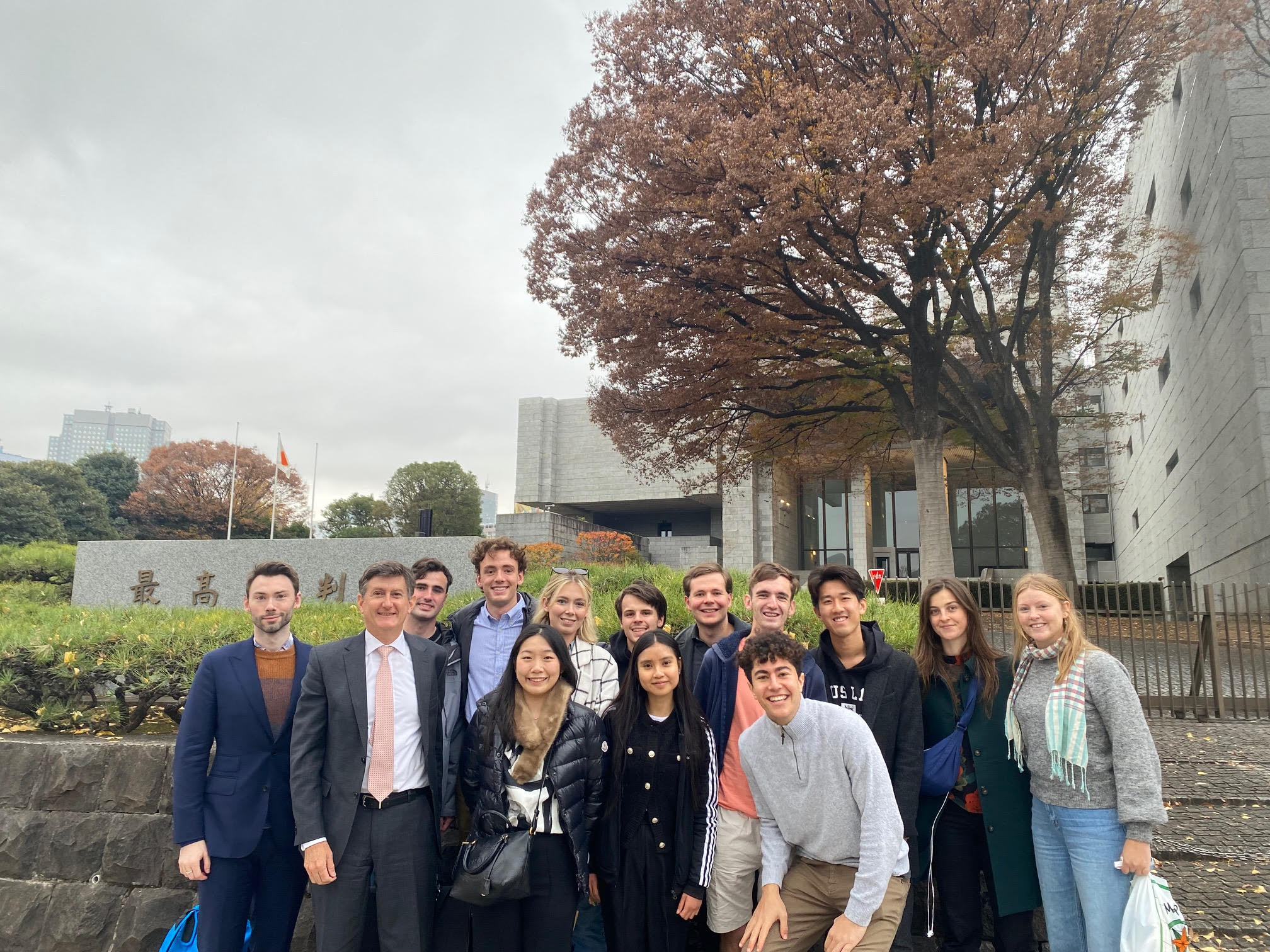
Importantly and deservedly, Team Australia won the ANJeL-sponsored prize for best (marks in) Teamwork. That was particularly impressive as the students have to cooperate cross-institutionally, and focus on moot preparations over the tense exam period. The students were also able to have a special tour of the apex Supreme Court, helped by ANJeL’s longstanding support for judicial visitors from Japan.

Special thanks to the lead coach and ANU law lecturer, James C. Fisher (and in past years Profs Kent Anderson and Veronica L. Taylor, ANJeL Advisors) as well as CAPLUS affiliate Nobumichi Teramura and Inma Conde for practice arbitrations. We are also grateful for support from DFAT (New Colombo Plan scholarships), Dean Simon Bronitt, Mitsui Matsushima and many past Moot alumni – including Ben Hines  and Irene Ma (both in the 2022 Team that also came second) and Eriko Kadota (now with Linklaters in Tokyo). For more details about this and past Teams see here.

Arbitration and Sports Law (Baseball) Dispute Resolution in Australia and Japan

As part of the Japanaroo suite of events, ANJeL is delighted to coordinate at Sydney Law School the two free public seminars below, both including a strong comparative focus on Japan and Australia, and involving a former Chief Justice of Victoria. One on Thursday 21 September compares arbitration’s historical trajectory (hybrid-format seminar, including two ANJeL program convenors based abroad – register via https://law-events.sydney.edu.au/events/intarbitrationaujp). The second on Friday 22 September compares sports law and dispute resolution (generally and with baseball as a major case study; in-person only, chaired by another ANJeL convenor Micah Burch – register via https://law-events.sydney.edu.au/events/globalsports-767).

1. Comparative History of International Arbitration: Australia, Japan and Beyond

This hybrid-format webinar compares the historical trajectory of international arbitration law and practice in Australia and Japan in regional and global contexts. An aim is to explore the evolving images and contours of arbitration and scope for cross-border collaboration in promoting this popular but sometimes contested form of dispute resolution.

Speakers

Commentator: Prof Luke Nottage (University of Sydney)(Drawing on the concluding chapter in his 2021 book: https://japaneselaw.sydney.edu.au/2020/08/book-in-press-with-elgar/ and his Encyclopedia entry on ACICA (with Prof Richard Garnett) at https://papers.ssrn.com/sol3/papers.cfm?abstract_id=4431276 )

Thursday 21 September

Time: 4-5.30pm

Location: The University of Sydney, Common Room, Level 4, New Law Building (F10), Eastern Avenue, Camperdown

Cost: Free, but registration is essential. Please select your attendance type during registration.

CPD points: 1.5 points

This event is being held an online and in-person at Sydney Law School. Please indicate your viewing preference when registering.

This event is proudly co-presented by the Centre for Asian and Pacific Law, the Resolution Institute and the Australian Network for Japanese Law at the University of Sydney Law School.

2. 2nd Annual Global Sports Law Symposium: Dispute Resolution

In-person event

This symposium brings together luminary experts and practitioners in sports law to discuss dispute resolution in the world of sports (it follows on from ANJeL’s seminar on international arbitration). The symposium’s first panel will feature two giants of the Australian sports law world reflecting on their careers in jurisprudence and sports administration resolving disputes in the sports area. The second panel will be a case study focusing on dispute resolution in baseball with two experts on both Japanese and Australian baseball.

About the Speakers

A. Dispute Resolution in Sports: Expert Reflections

Professor Deborah Healey (University of New South Wales)

Deborah Healey is the Director of the Herbert Smith Freehills China International Business and Economic Law (CIBEL) Centre and the Editor of the Sports Law Journal. She has more than 30 years of experience serving on the boards of major sports governance organizations and serves on the National Sports Tribunal.

Professor the Hon Marilyn Warren AC KC (Monash University)

Marilyn Warren is a Vice Chancellor’s Professorial Fellow of Monash University and is the former Chief Justice of Victoria. She practices as a commercial arbitrator and teaches law as a Professor at Monash’s Law Faculty.

B. Dispute Resolution in Sports: Baseball Case Study

Mr. Mark Marino (CEO, Baseball NSW)

Mark Marino has been the CEO of Baseball NSW since 2014 and is an Executive Committee Member of the Australian Baseball Players Alumni Association. Mark played collegiate and professional baseball in the United States and was the CEO of the Sydney Blue Sox 2014-2018.

Dr. Matt Nichol (Lecturer, Central Queensland University, (Melbourne))

Matt Nichol is a lecturer and sports law academic at the School of Business and Law at Central Queensland University and a board member of Baseball Victoria. His research uses approaches to labour law and regulatory theory to understand the regulation of labour in professional team sports.

Moderator: Mr. Micah Burch, Senior Lecturer, Sydney Law School.

Hosts: Sydney Law School, Australian Network for Japanese Law, Australia New Zealand Sports Law Association

Date: Friday, 22 September 2023

Time: 4.00-5.30pm

Location: Common Room, Level 4, New Law Building (F10), The University of Sydney

Please follow directional signage on arrival.

CPD Points: 1.5

This event is proudly co-presented by The University of Sydney Law School, the Australian Network for Japanese Law and the Australia New Zealand Sports Law Association.

History of International Arbitration in Japan

[This is the Introduction to a draft chapter written with ANJeL-in-ASEAN Convenor Asst Prof Nobumichi Teramura, for a book being edited by Lars Markert et al on International Arbitration in Japan]

Arbitration has had quite a long modern history in Japan, including a fascinating inter-state dispute that arose in 1872 (Part 2 below). The first arbitration legislation, modelled on German law, was enacted in 1890 and survived for over a century (Part 3).

In 1961, Japan also became one of the first states in Asia, indeed world-wide, to ratify the 1958 New York Convention on the Recognition and Enforcement of Foreign Arbitral Awards (NYC). A few years after the 1985 release of the United Nations Commission on International Trade Law (UNCITRAL) Model Law on International Commercial Arbitration (ML), a group comprising mostly academics proposed new legislation based on that emerging global standard. However, the concept was only enacted 15 years later as the Arbitration Act (Law No 138 of 2003),[1] as part of the government’s broader package of reforms into justice system reforms. Instead, in 1996, legislation was amended to allow “fly-in” foreign lawyers (in addition to “foreign law solicitors” registered in Japan under legislation since 1986) to represent clients in international arbitrations in Japan. Their scope of permitted practice was somewhat expanded in 2021, as part of the government’s initiatives from 2018 to have Japan catch up with larger regional hubs for international arbitration. As another part of that program, the first amendments to the Arbitration Act were approved in 2023 (Part 4).

Despite this rather slow development of cutting-edge legislation for international arbitration in Japan, the courts have been comparatively consistent in rendering pro-arbitration decisions complying with the NYC and ML as international instruments (Part 5). Japan’s two main arbitration institutions, The Tokyo Maritime Arbitration Commission (TOMAC, established in 1926) and the Japan Commercial Arbitration Association (JCAA, established in 1953), have also helped keep arbitration practices updated by periodically revising their Arbitration Rules. The government’s push since 2017 to promote Japan more actively as a seat has led to further new Rules as well as new arbitral institutions, including for sports and intellectual property disputes (Part 6).

Japan has also become a comparatively active proponent of investor-state dispute settlement (ISDS) arbitration provisions in international investment agreements, although again after a slow start. Japan has seen few outbound and even fewer inbound ISDS arbitration claims. However, this means that arbitration generally may not attract as many negative associations with the general public as in other states experiencing more and/or high-profile ISDS arbitration claims from foreign investors (Part 7).

Despite such positive developments, arbitration has not yet captured the imagination in Japan. The general public remained quite unfamiliar with it, although awareness nowadays may be improving. Indeed, one colloquial understanding or definition of arbitration (chusai) was closer to mediation (chotei), even though the latter does not involve imposition of a binding decision by the agreed third-party neutral.[2] This confusion may have persisted from the Tokugawa era (1603-1867),[3] when notions of judiciable rights were comparatively weak and mediation was actively practiced to resolve civil disputes.[4]

As for awareness among Japanese firms in the modern era, the larger ones have long been quite familiar with the advantages of including arbitration clauses especially in maritime matters and other cross-border commercial contexts. Accordingly, some have got involved in some arbitrations and even some high-profile related court proceedings particularly abroad. In addition, sustained efforts by arbitral institutions and business associations since World War II have made smaller and medium sized enterprises more likely to include arbitration clauses in their own growing cross-border trade and then investment contracts, although many probably remain quite unfamiliar with arbitration. Furthermore, as a whole, Japanese firms have been more willing to agree to arbitration clauses specifying a seat outside Japan. In addition, they have appeared more reluctant actually to proceed with arbitration claims even under such clauses, or locally when the seat is agreed to be in Japan, compared to companies from other states in Asia and beyond.[5]

The result has been that Japan’s major arbitration institutions have not yet seen the significant growth in international case filings evident in several states in the region. Arbitration is also still used infrequently to resolve domestic commercial disputes. As with Japan’s still comparatively low per capita civil litigation rate, the reasons may be related to (general, organisational or legal) culture or institutional barriers (including comparatively few lawyers, experts, arbitrators and institutions pro-actively specialising in the field, at least until recently). These questions, and therefore the prospects for expanding arbitration services in Japan, are explored further in the Conclusions (Part 7).


[1] For a semi-official translation, see Japan Ministry of Justice, ‘Arbitration Act (Act No. 138 of 2003)’ (Japanese Law Translation) https://www.japaneselawtranslation.go.jp/en/laws/view/2784 accessed 14 April 2023.

[2] Tatsuya Nakamura, Chusaiho Gaisetsu [Outline of Arbitration Law] (Seibundo Shinkosha 2022) 1.

[3] Yoshihisa Hayakawa, ‘Nihon ni okeru Chusai no Rekishiteki Isou [Historical Phases of Arbitration in Japan]’ (2015) 87 Horitsu Jiho 19, 19-20.

[4] Nonetheless, some litigants did actively press their rights even during this pre-modern era, when Japan largely closed itself off from the wider world: see e.g., Herman Ooms, Tokugawa Village Practice: Class, Status, Power, Law (University of California Press 1996).

[5] Compare generally [[X-ref to Chapter 3 (Japan as seat) in this volume].

Japan’s International Investment, Evolving Treaty Practice and Arbitration Related to Corruption and Illegality

Written by: Luke Nottage and Nobumichi Teramura#

Abstract: This article forthcoming in 55 Journal of Japanese Law (mid-2023), part of an interdisciplinary book project on Corruption, Illegality and Asian Investment Arbitration [including a conference held in Brunei on 29 May 2023 (booklet here) supported by ANJeL and CAPLUS], addresses for Japan the difficult practical and policy question facing arbitration tribunals when a foreign investor claims mistreatment by a host state but the latter alleges that the investment was tainted by corruption or other similar serious illegality. By way of background, Japan emerged from the 1980s as a leading exporter of foreign direct investment (FDI). Yet it has low inbound FDI despite some significant growth since the late 1990s (Part II). This is despite Japan having comparatively very little corruption, which is often problematic for foreign investors (Part III).

To protect and promote outbound FDI after a hesitant start, over the last two decades, Japan has accelerated ratifications of standalone bilateral investment treaties (BITs) as well as investment chapters in free trade agreements (FTAs). Almost all allow foreign investors from the home state to directly initiate investor-state dispute settlement (ISDS) arbitration against host states to get relief from violations of substantive treaty commitments, such as non-discrimination or compensation for expropriation (Part IV.1).

Japan’s investment treaty practice on corruption and illegality is comparatively interesting for two reasons (Part IV.2). First, from around 2007, its treaties have often required host states to take measures against corruption. This should help Japan’s outbound investors, but these obligations are generally weakly phrased. Secondly, Japan’s treaties have been less consistent in expressly limiting their protections to foreign investments made in accordance with host state laws (including against corruption). This may be due to treaty drafters from Japan and counterparty states being less aware of the significance of such express legality provisions, which will often lead tribunals to decline jurisdiction if corruption is established, thus leaving foreign investors without treaty protections. Such outcomes may also incentivise host states to ensure a bribe is taken, to use as a treaty defence if foreign investors ever launch treaty claims, whereas other outcomes for tribunals are possible if there is no express legality provision. Another possibility is that this drafting is deliberate, again to benefit Japanese outbound investors as claimants because the absence of a legality provision renders more difficult defences from host states, which typically have more corruption than in Japan.

Japan may adopt more and clearer legality provisions if it becomes subject to more inbound ISDS arbitration claims, and/or if claims by Japanese outbound investors are mostly against well-governed host states with little scope for corruption. Yet both types of claims remain few (Part V). The shift may therefore come more from other counterparty states pushing for such legality provisions and Japan agreeing in its future treaties to demonstrate its overall commitment to combatting corruption, and to preserve the legitimacy of the ISDS arbitration system (Part VI).


# Respectively: Professor, University of Sydney Law School; Assistant Professor, Institute of Asian Studies, Universiti Brunei Darussalam.