Japanese Law in Asia-Pacific Socio-Economic Context
Author: Luke Nottage
Prof Luke Nottage (BCA, LLB, PhD VUW, LLM LLD Kyoto) is founding co-director of the Australian Network for Japanese Law (ANJeL), Associate Director (Japan) of the Centre for Asian and Pacific Law at the University of Sydney (CAPLUS), and Professor of Comparative and Transnational Business Law at Sydney Law School. He specialises in international dispute resolution, foreign investment law, contract and consumer (product safety) law.
Nobumichi Teramura and I have published this article (open-access) in volume 42 of Arbitration International(2026) as a sorry saga, but far from a representative case, of what can go wrong with long-term investment contracts containing dispute resolution clauses in Asia. The Abstract is below and Powerpoints summary here.
Abstract: This article tracks the ongoing saga of the claim brought by heirs of the Sultan of Sulu against Malaysia as successor to the British North Borneo Company, based on a concession agreement in 1878. After outlining the complex colonial-era history, and the dispute after Malaysia suspended concession payments in 2013 (Section 2), Section 3 details ad hoc arbitration proceedings commenced in Spain in 2017. This phase includes the 2019 court appointment of the arbitrator and then his removal, as well as issuance of a 2020 preliminary award on jurisdiction and applicable law (the UNIDROIT Principles) followed by its annulment, alongside a Malaysian court’s anti- arbitration injunction in 2020. Section 4 explains attempts to move the seat to France and enforce awards there, including the 2022 Final Award of around USD 15 billion (Section 5), before the 2023 criminal conviction of the arbitrator by Spanish courts (Section 6). The heirs have attempted nonetheless to enforce the Final Award against Malaysian assets in the Netherlands and Luxembourg, unsuccessfully (Section 7). The heirs also commenced an arbitration in 2024 under the 1993 Philippines—Spain bilateral investment treaty, notably alleging denial of justice in Spanish courts, and failed (Section 8). The Sulu saga raises significant conceptual and practical issues in international arbitration, raising public scepticism about its legitimacy (including costs and delays) beyond Malaysia.
I will present on the above topic at the monthly meeting of the International Law Research group (kokusaiho kenkyukai) on Saturday 26 September 2026 1.15-3pm at the University of Tokyo Faculty of Law (Building No 3) – the day before I return to the University of Sydney to work a year before my next six-month stint annually in Tokyo on tenured cross-appointment. The paper will be published this year in a special issue of the Griffith Law Review, freely available in Open Access, with the [slighted edited] Abstract below and and summary powerpoints available here:
Abstract: This article outlines Australia’s renewed stance against investor-state dispute settlement (ISDS) arbitration in international investment agreements (IIAs) (Part 2). This intensifies the Labor Government’s anti-ISDS position over 2011-13, mirrored by New Zealand’s Labour Government over 2017-2023. Concerns have also been raised in Europe over the last 10-15 years about ISDS procedures and IIAs, as developed economies experienced inbound ISDS claims. From 2015, the European Union (EU) promoted an investment court alternative. Part 3 examines experiences in significant economies in Asia, with net or large outbound stocks of foreign direct investment (FDI) that typically favour the stronger IIA provisions, and net FDI-importing economies. Most remain open to agreeing to ISDS, while agreeing to an investment court in IIAs with the EU. Part 4 details antipodean negotiations with the EU, and two mega-regional treaties involving also Southeast Asia [with RCEP including Japan] where ISDS is subject to ongoing work programs. Part 5 concludes that Australia and New Zealand have an opportunity to join with some Asian states [including potentially Japan] in seriously considering an investment court alternative to traditional ISDS, or at least key features thereof, as a more sustainable compromise way forward to concluding balanced trade and investment agreements regionally and even multilaterally.
Keywords: international investment law, arbitration, ISDS, Australasia, Asia, European Union
第452回東大国際法研究会
下記により開催いたしますので、ご出席下さいますようご案内申し上げます。
研究会代表 寺谷広司
記
(日時)2026年9月26日(土)13:15~
(場所)東京大学法学部研究室(法学部3号館)203会議室、及びZoomによるハイブリッド形式
※ いずれかご都合のよい方式でご参加ください。
(報告者・題目) Luke Nottage 氏(東京大学/シドニー大学) “Evolving Antipodean, Asian and European Ambivalence Around ISDS Arbitration: A Compromise Way Forward?”
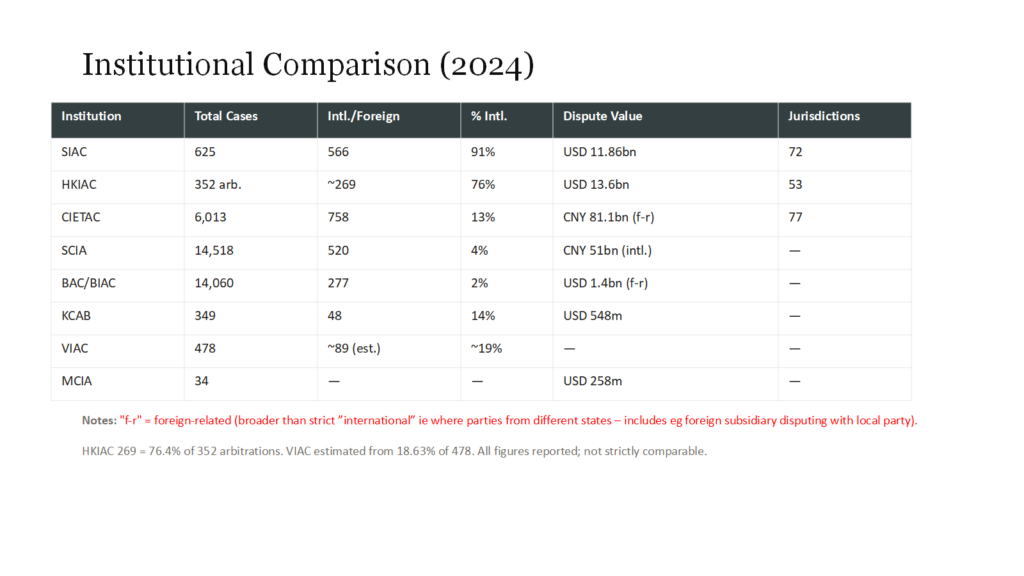
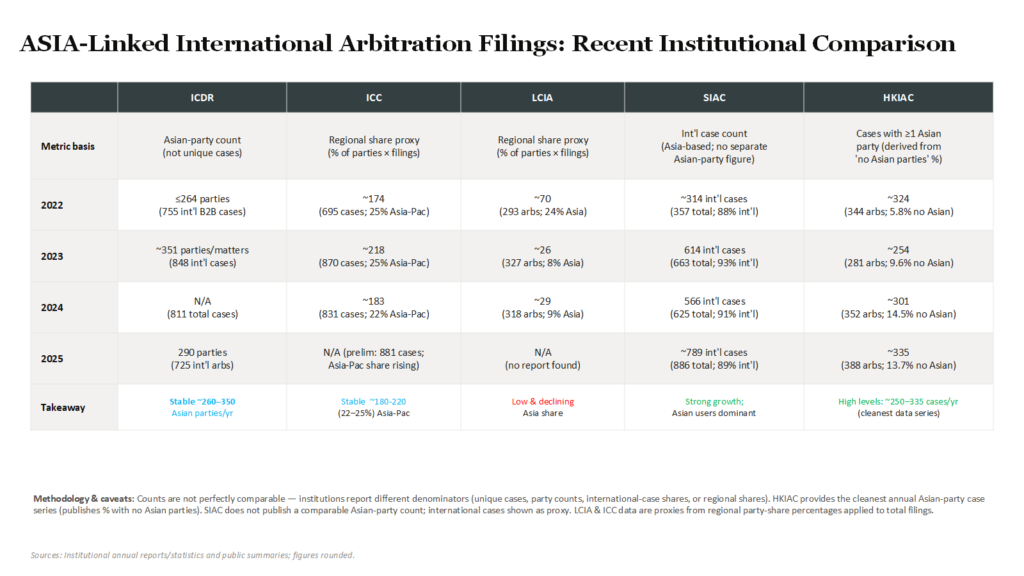
USyd Prof Vivienne Bath and I are writing a chapter on this (and Mediation) for the Oxford Handbook of International Trade Law in Asia (co-edited by Prof Julien Chaisse et al). Due to the tight word limit we move here some of our material, for readers interested in delving more deeply or widely into the topics compared to our published version. In particular, we delve deeper into the headline statistics on international commercial arbitration (ICA) case filings recorded across Asian institutions, especially in Singapore, compared say to Harvey AI which produced the summary Tables below: the first for Asia-based arbitral institutions, and the second adding Asia-related ICA case numbers for major non-Asian institutions:
Introduction
Asia is a large and diverse region, with disparate systems of law and dispute settlement. These range from China’s socialist legal system with influences from across the world; the common law jurisdictions of India, Pakistan, Hong Kong, Singapore and Malaysia; and the civil law systems of Japan (with common law infusions), Korea, Thailand, Indonesia and others regionally. Each has its own history and features, reflecting local conditions. In the space available, it is not possible to discuss all of these jurisdictions.[1] This chapter looks mainly at international commercial arbitration (ICA) through major arbitral institutions particularly North and Southeast Asian Region, focusing on the three centres in the region which have had the most success in attracting arbitration case filings both regionally and internationally and in building international reputations: Singapore International Arbitration Centre (SIAC), Hong Kong International Centre (HKIAC) and China International Economic and Trade Arbitration Centre (CIETAC). It briefly discusses other developments in some other Asian centres, as well as ad hoc arbitration (especially in India) and international mediation.
ICA (as well as domestic arbitration, in some states) has grown strongly in Asia since the 1990s – especially over the last 15-20 years. This confounds some commentators who argued arbitration would not flourish due to “Asian values” favouring harmony and consensual dispute resolution (DR).[2] Yet there has been limited growth in international commercial mediation (and indeed domestic mediation for business disputes) from private suppliers of mediation services. This is despite some emergent government and institutional support in some Asian countries for mediation in cross-border commercial disputes, and many signings – albeit still not many ratifications – of the 2018 Singapore Mediation Convention.[3]
The chapter examines the relationship between the growth of arbitration and the functionality of domestic courts and wider civil justice systems; enforceability problems across the region; and the role of government as well as the courts in supporting ICA and mediation.
Overall development of Asian arbitration
Governments in Asia have increasingly shown an interest in encouraging ICA. With the exception of North Korea, almost all Asian nations are parties to the 1958 New York Convention on the Recognition and Enforcement of Foreign Arbitral Awards (NYC).[4] The enforcement regime for arbitral awards under the New York Convention offers substantial potential benefits over domestic court systems and the difficulties of enforcing foreign judgments.
To create a viable alternative DR forum for international commercial contracts, and to clarify the role of domestic courts in supervising arbitrations, many Asian nations also updated their arbitration statutes. Many adopted in some form, as a reputable international template, the United Nations Commission on International Commercial Arbitration (UNCITRAL) Model Law on ICA (ML).[5] Other states may be influenced by ML concepts and other international developments. China (discussed below) provides a good example.
In addition, many Asian nations (except notably India, Thailand and Vietnam) have acceded to the framework 1965 Washington Convention, assisting enforcement of investor-state dispute settlement (ISDS) arbitration through the International Centre for the Settlement of Investment Disputes (ICSID).[6] ISDS is briefly mentioned as it enhances familiarity with international arbitration generally, albeit sometimes generating controversy.[7] Most Asian nations (except Myanmar and Nepal) are also contracting parties to the Permanent Court of Arbitration, with Indonesia (2026) the most recent Asian nation to accede.[8]
There has also been substantial growth in the number of arbitral institutions across Asia offering ICA and/or quite often mediation services. Some have attracted significant number of ICA filings, but these may not be widely known. For example, the Vietnam International Arbitration Centre (VIAC) has recorded a considerable increase in arbitrations filed, especially over the last three years.[9] Yet the success of the numerous institutions around Asia in attracting ICA remains highly variable, with some very successful institutions (discussed below in more detail) and other institutions that have hardly attracted any international cases.
Overall, despite the lack of concrete region-wide statistics, it appears that there has been strong growth in ICA in the Asian region taken as a whole. Recent statistics published by the International Chamber of Commerce (ICC), for example, indicate substantial interest in ICA across Asia. Of the 881 cases filed under the ICC Arbitration Rules in 2025, 13.9 percent were from East and South Asia and the Pacific while 10.6 percent were from the Middle East and Central Asia.[10] Another Western-headquartered arbitration institution with a significant caseload involving Asian parties is the International Centre for Dispute Resolution (ICDR), created as a specialist division of American Arbitration Association in 1996. For example, it recorded 848 international cases filed in 2023, when about 351 Asian parties used ICDR services (174 from China and 32 from India, the second-largest group).[11]
Statistics published by individual Asia-based institutions also show mostly an increase in cases, albeit with some variability and exceptions.[12] However, care is needed (and exemplified below) when analysing reported ICA statistics. First, some centres (notably CIETAC and VIAC) adopt a broader definition of “international” when counting cases, extending beyond “truly” international cases where parties come from different states (the main ML definition) to encompass foreign related or “quasi-international” cases between a local company and an affiliate of a foreign company. Secondly, some institutions may count cases “handled”, including not only those administered under their own Rules, but also those under others like the UNCITRAL Arbitration Rules designed originally for ad hoc arbitration (so with the institution playing more limited roles), or even where the institution makes a default arbitrator appointment under background arbitration law (as with SIAC).
In addition to ad hoc arbitration, plus institutional arbitrations administered under ICC and ICDR Rules, three (more or less state-backed or supported) Asian institutions have been particularly successful, not just in the region but also for users outside Asia. According to the most recent well-regarded international arbitration survey by Queen Mary University of London with White & Case,[13] Singapore, Beijing and Hong Kong were all ranked globally in the top five seats for ICA, along with London (first) and Paris (fifth). Their arbitration rules were similarly ranked highly: third was SIAC, second was HKIAC and sixth was CIETAC, after ICC (first), the London Court of International Arbitration (LCIA, fourth) and the UNCITRAL Rules (fifth). While all three are in the top five most preferred arbitration rules by region (with the ICC and Shenzhen Court of International Arbitration or SCIA, in the Asia-Pacific), only Singapore (along with LCIA) has the distinction of being in the top five in all regions. HKIAC and SIAC have been particularly successful in attracting arbitrations from areas outside Hong Kong and Singapore. SIAC became very attractive to Indian parties. HKIAC has a strong international clientele, but is especially attractive to parties to China-related arbitrations. CIETAC, unsurprisingly, has been popular with Chinese parties.
[1] See generally eg Julien Chaisse and Luke Nottage (eds), International Investment Treaties and Arbitration Across Asia (Brill 2018); Michael J Moser (ed), Arbitration in Asia (2nd edn, JurisNet 2022); Raymond Leung, Asia Mediation Handbook (Sweet & Maxwell 2015); Shahla Ali and others (eds), New Frontiers in Asia-Pacific International Arbitration and Dispute Resolution (Kluwer Law International 2021); Nobumichi Teramura, Luke Nottage and Bruno Jetin (eds), Corruption and Illegality in Asian Investment Arbitration (Springer 2024) (open access) <https://link.springer.com/book/10.1007/978-981-99-9303-1> accessed 27 July 2026. [could consider cutting down this footnote if short of space LRN well we have to cut hugely especially eg Parts 1 and 2 anyway]
[2] cf generally Michael Pryles and Veronica Taylor, ‘The Cultures of Dispute Resolution in Asia’ in Michael Pryles (ed), Dispute Resolution in Asia (Kluwer Law International 1997) 1.
[3] United Nations Convention on International Settlement Agreements Resulting from Mediation (adopted 20 December 2018, entered into force 12 September 2020) (Singapore Convention on Mediation). See generally Nadja Alexander, Shouyu Chong and Vakho Giorgadze, The Singapore Convention on Mediation: A Commentary (2nd edn, Kluwer Law International 2022).
[5]Adopters include Azerbaijan, Bangladesh, Bhutan, Brunei Darussalam, Cambodia, Hong Kong, Macao, India, Japan, Korea, Malaysia, Myanmar, the Philippines, Qatar, Singapore, Sri Lanka, Thailand and the UAE. The ML has not been adopted in Afghanistan, China, Indonesia, Kazakhstan, Lao PDR, Nepal, Taiwan or Vietnam. See UNCITRAL, UNCITRAL Model Law on International Commercial Arbitration (1985), with amendments as adopted in 2006; adoption status at <https://uncitral.un.org/en/texts/arbitration/modellaw/commercial_arbitration/status>.
[6]Convention on the Settlement of Investment Disputes between States and Nationals of Other States (adopted 18 March 1965, entered into force 14 October 1966) 575 UNTS 159 (ICSID Convention); ratification status at <https://icsid.worldbank.org/about/member-states/database-of-member-states> accessed 27 July 2026.
[7]Teramura, Nottage and Jetin (n 1); Luke Nottage, ‘Evolving Antipodean, Asian and European Ambivalence Around ISDS Arbitration: A Compromise Way Forward?’ (2026) 34 Griffith Law Review (forthcoming).
[9]Vietnam International Arbitration Centre, ‘Statistics on Dispute Resolution Activities in 2025’ <https://viac.vn/en/statistics/statistics-on-dispute-resolution-activities-in-2025-s49.html> accessed 27 July 2026. Although almost half of the 532 cases filed in 2025 were foreign-related, this may include foreign invested enterprises in Vietnam rather than foreign parties.
[10] International Chamber of Commerce, ‘ICC Dispute Resolution 2025’ <https://www.iccwbo.org> accessed 9 August 2026.
[12]Each institution has its own way of setting out statistics, particularly in relation to the question of what constitutes a foreign or international case.
To bolster cross-border investment and trade, Singapore was quite quick within Asia to ratify the NYC, in 1986. After the ML was agreed in 1985, Singapore also adopted that as the template for its International Arbitration Act 1994. For domestic arbitrations, Singapore replaced its remaining arbitration statute based on English law with the ML-based Arbitration Act in 2001. It has not integrated the two statutes into one, as is the case in Hong Kong. Nor has Singapore (unlike Hong Kong) adopted the 2006 ML amendments – although a 2009 amendment to the International Arbitration Act does allow enforcement of (local and foreign-seated) arbitrators’ interim measures orders.
Singapore also still shows some deference to English case law in some respects, where the ML is unclear or has gaps. Notably, its courts maintain a complex multi-step approach to determine the law applicable to the arbitration agreement when the parties have not expressly agreed on this.[1]
Overall, partly because Singapore adopted the ML later than HK, case law was less internationalist in applying its international arbitration legislation. However, 2001 and 2002 the legislature promptly amended its Act following judgments addressing implied opting out of the ML regime from parties’ choice of Rules, which were unhelpful in promoting Singapore as a seat.[2] Singaporean judgments subsequently became arguably as internationalist as Hong Kong’s judgments. This pattern can be seen for example in substantial deference by Singaporean courts to the procedural decisions of arbitrators,[3] although they still intervene in egregious cases.[4]
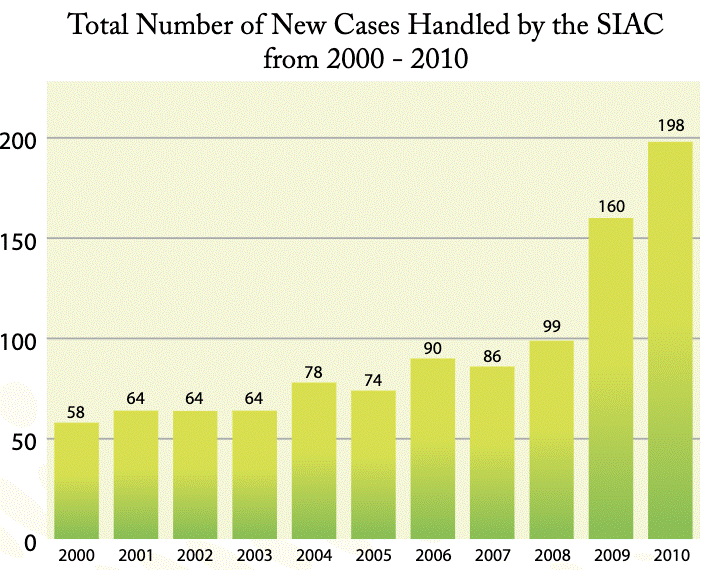
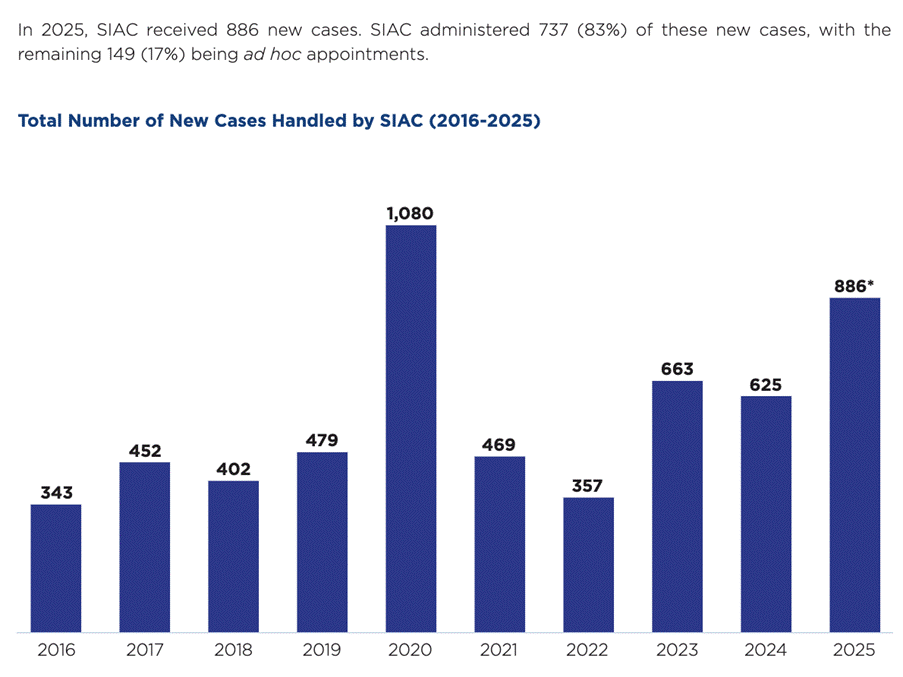
The Singaporean government and judiciary promoted ADR from the 1980s primarily to address delays in civil litigation, focusing on mediation,[5] but it also encouraged establishment of SIAC in 1991. SIAC already then introduced its first set of standalone Arbitration Rules, with the most recent (7th) edition published in 2025 after extensive public consultation. However its caseload only grew slowly through to 2008, when it reached 99 cases filed, before jumping to 160 in 2009 and 198 in 2010:[6]
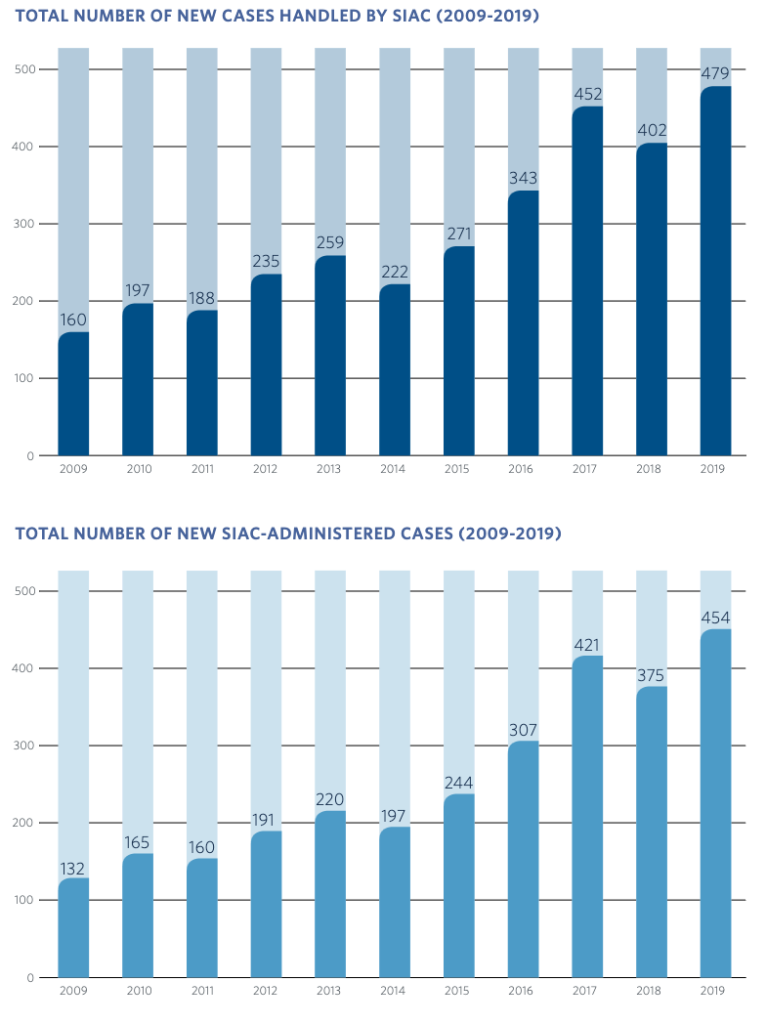
By 2019 there were 479 cases handled (87% international), including 25 cases (5% of [2][3][4][5] the total) limited to making default appointments of arbitrators in otherwise ad hoc proceedings.[7] The latter arises through parties’ prior agreement to this restricted role for SIAC, eg by specifying it as the appointing authority but otherwise arbitrating under UNCITRAL Rules, or in purely ad hoc proceedings with no agreed Rules but with SIAC as default appointing authority under the 1994 Act. The 2019 Annual Report implies that from 2009, where the proportion of default appointments for ad hoc proceedings was 17.5% (28 out of 160 total cases handled), the proportion declined more or less consistently to 6.7% by 2018.
This decline continued from 2019 into the 2020s (excluding an anomaly in 2025), showing SIAC’s evolution into a full-service institutional arbitration provider and the broader global trend favouring institutional over ad hoc arbitration. Thus, in 2021 SIAC recorded handling 469 cases, with 5% being only default appointments.[8] Yet in 2025 SIAC handled 866 cases (89% international), but this included 149 default appointments (a remarkable 17% of the total) – so cases involving full administration by SIAC (under its Rules) comprised only 717 cases, both domestic and international.[9]
However, it seems that that 135 of the 149 default appointments were in “related cases”[10] (though counted separately), which likely explains this significant jump. Somewhat similarly, SIAC had declared a record 1080 cases for 2020, yet the numbers of all arbitrators appointed (almost all for cases under its own Rules) remained similar to 2019 – one commentator adds this suggested:[11] “a smaller number of arbitrations than appears on the face as SIAC allows arbitrations under associated contracts to be commenced in a single notice of arbitration (for the purpose of the case statistics these count as multiple cases)”.
Indeed, as mentioned above, the annual new cases handled by SIAC dropped down again to 469 in 2021 (similar to 2019), before resuming steady growth through to 866 cases in 2025 (although only 717 fully administered).
SIAC’s significant step up in cases filed over 2009-10 was likely assisted by a delayed impact from disputes arising from the 2007 Global Financial Crisis, since other international arbitration institutions (including HKIAC) also saw an increase around that time. But SIAC also benefited by the inauguration of Maxwell Chambers in 2010 (and greatly expanded in 2019, unveiled the day after the signing ceremony for the Singapore Mediation Convention). [1] The government contributed significantly to the refurbishment of this public property, with state-of-the-art hearing rooms and office space not only for smaller practitioners and SIAC but other arbitral organisations.
In addition, SIAC’s third edition Rules (2007) started shifting away from the UNCITRAL Rules core characterising the first (1991) and second (1997) editions.[2] This accelerated with the 2010 Rules (fourth edition), adding innovative Emergency Arbitrator and Expedited Arbitration procedures. Notably also from 2007, to encourage efficiency by arbitrators SIAC moved from the traditional LCIA (and still HKIAC) remuneration on an hourly rate, to fees based on dispute amount (as in the ICC).
The SIAC 2013 Rules (fifth edition) were also noteworthy by adopting a new structure for governance. It created the SIAC Court of Arbitration, modelled on the ICC Court and LCIA Court. The Court was to decide challenges to arbitrators and objections to SIAC’s prima facie jurisdiction, determine matters of arbitration policy, and oversee case administration and SIAC Secretariat work. The SIAC Board of Directors was refocused on business operations, marketing and development, and corporate governance. Dr Michael Pryles from Australia, appointed Chairman of the Board from 2009, became the founding President of the SIAC Court. That also comprised 16 leading arbitration practitioners from many jurisdictions,[3] mimicking the ICC Court’s multinational character to give SIAC credibility as a truly global institution. This was reinforced by appointing as President, from the USA, Gary Born from 2015 and Lucy Reed from 2021.
[2] See SIAC, ‘Administered Arbitration’ <https://siac.org.sg/administered-arbitration> and generally John Choong, Mark Mangan and Nicholas Lingard, A Guide to the SIAC Arbitration Rules (2nd edn, Oxford University Press 2018).
Since the 2010 and 2013 SIAC Rules (from the 4th and 5th editions onward), draft awards are submitted to the Registrar (heading the Secretariat) who may suggest modifications as to the form, similarly to the ICC. Such developments helped SIAC to market itself also as a high-quality institution (with commensurate administration fees), to attract cases and bolster cross-border enforceability prospects. Singapore Courts provided assistance by upholding in 2010 an earlier arbitration agreement providing for ICC Rules arbitration administered by SIAC, indicating for example that the SIAC then Board could perform some of the ICC Court functions.[12]
The SIAC Rules 2016 (sixth edition) kept attracting attention through innovations such as a procedure for early dismissal of claims manifestly without legal merit (adapted from ICSID Arbitration Rules), along with expanded provisions for multiple contracts, consolidation and joinder (reflecting the increasing complexity of arbitrations being filed – although such patterns are also found in HKIAC and other arbitral centres). The 2025 SIAC Rules expanded significantly in length, notably adding introducing ex parte emergency relief (protective preliminary orders) and a Streamlined Procedure for smaller claims than under the Expedited Procedure track).
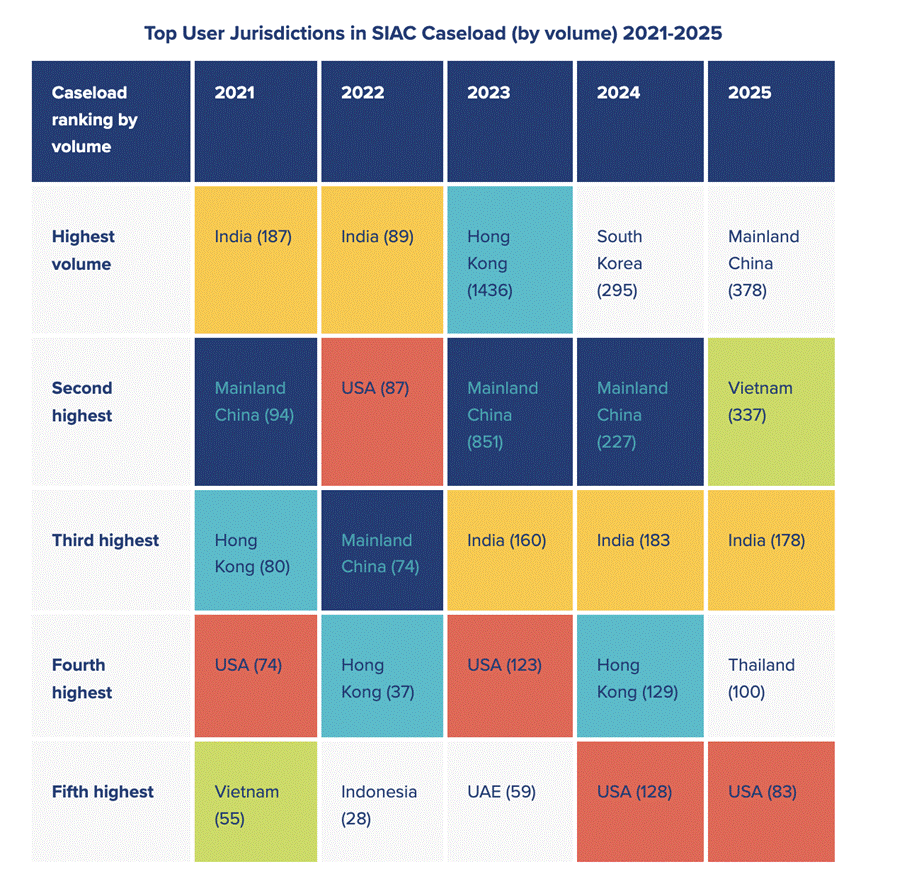
SIAC also benefited from the growth of intra-Asian trade and investment, especially the rise of India, where it enjoyed a significant advantage over Hong Kong and China. The latter were only gazetted under Indian law for enforcement of their awards in 2012, whereas Singapore was in a first group of gazetted countries dating back to India’s Foreign Awards (Recognition and Enforcement) Act 1961.[13] Indian parties therefore began arbitrating extensively in Singapore, which marketed itself heavily in India – setting up two offices there from 2013.[14] However in recent years the proportion of Indian cases in SIAC has dropped (by numbers) relative to those involving China and Hong Kong.[15]
SIAC further introduced Investment Arbitration Rules in 2017. However, SIAC does not report any case applying them, despite having “administered investment disputes under standard SIAC Rules and … served as the appointing authority in investment disputes under the UNCITRAL Arbitration Rules”.[16] This is not too unexpected as the usual way nowadays for investment arbitration rules to apply in ISDS is through being provided as an option for foreign investors under investment treaties, sometimes dating back decades; and those currently overwhelmingly list ICSID and/or UNCITRAL Rules. SIAC’s Rules however can be marketed more now that Singaporean courts have developed significant experience in dealing with ISDS cases.[17]
The Singapore Chamber of Maritime Arbitration (SCMA) was established in 2004 under SIAC management. However, especially after feedback that the maritime community preferred a non-administered, ad hoc-style model rather than the fully administered institutional model that SIAC was increasingly adopting, SCMA —reconstituted in May 2009 as an independent organisation. It adopts a “light touch” self-administered model, deliberately modeled on the London Maritime Arbitrators Association (LMAA) rather than on administered institutions like the ICC or SIAC.
It has seen some significant growth, from over 100 cases during 2009-11 (combined with SIAC[18]), 43 just in SCMA in 2020, and 95 in 2024. Over 50% of parties involved in SCMA disputes are not Singapore-based. Singapore’s overall share of global maritime arbitration has grown from approximately 5% of London’s volume in 2022 to 9% in 2024. The recent surge has been attributed in part to the global trade war, which has generated increased shipping and trade disputes in the Asia-Pacific region.[19]
[2] Mohan Pillay, ‘The Singapore Arbitration Regime and the UNCITRAL Model Law’ (2004) 20(4) Arbitration International 355. By contrast, a revision to Australia’s International Arbitration Act came only in 2010, by preventing opting out altogether (s 21) to counteract similarly unhelpful case law.
[3]Luke Nottage, ‘Deference from National Courts to Tribunals on Issues of Procedure at the Post-Award Stage’ in Franco Ferrari and Friedrich Rosenfeld (eds), Deference in International Commercial Arbitration: The Shared System of Control in International Commercial Arbitration (Kluwer Law International 2023).
[4] Eg BZV v BZW [2022] SGCA 1 (setting aside a SIAC award found ‘manifestly incoherent’) and DJO v DJP[2024] SGHC(I) 24, upheld in DJP v DJO [2025] SGCA(I) 2(setting aside upheld on appeal, where a SIAC award was tainted by the tribunal – including former Chief Justice of India Dipak Misra – self-plagiarising from an award rendered in India arising from the same project).
[5] Eugene Tan, ‘Harmony as Ideology, Culture, and Control: Alternative Dispute Resolution in Singapore’ (2007) 9(1) Australian Journal of Asian Law 120.
[6] SIAC, ‘CEO Annual Report 2010’ 3 (the first available via <https://siac.org.sg/annual-reports> accessed 27 July 2026). This and other early Annual Reports do not specify the proportions of international cases, but this may have been lower than the proportions that later started being annually reported (over 85%).
[9]SIAC, ‘Annual Report 2025’ 26–27 <https://siac.org.sg/wp-content/uploads/2025/09/SIAC-Annual-Report-2025.pdf>. The Annual Report does not break down the proportion of international cases for this subset of 717 cases; it may be more or less than the 89% recorded for the total 866 cases.
[10] Herbert Smith Freehills Kramer, ‘SIAC Annual Report 2025: Key Statistics, Trends and Takeaways for International Arbitration’ (2026) <https://www.hsfkramer.com/notes/arbitration/2026-5/siac-annual-report-2025-key-statistics-trends-takeaways-for-international-arbitration> accessed 27 July 2026.
[11]Amanda Lees, ‘SIAC Statistics: Looking Behind the Large Increase in SIAC Caseload’ (Mallesons Pulse, 29 April 2021) <https://pulse.mallesons.com/international-arbitration/siac-statistics-looking-behind-the-large-increase-in-siac-caseload> accessed 27 July 2026 – adding as other possible explanations for this anomalous spike in 2020: ‘a large number of cases in which the tribunal is yet to be appointed due to delay by the parties in paying their deposits … and arbitrations being commenced for limitation or settlement purposes only and then stayed’.
[13] Michelle Bradfield and Daniel Harrison, ‘India to Recognise and Enforce Arbitral Awards from China’ (Lexology, 1 October 2012) https://www.lexology.com/library/detail.aspx?g=f817c2a2-6f53-4c62-afb0-22545a790fc8 accessed 27 July 202; Government of India, Ministry of Law and Justice, Notification SO 2252(E), Gazette of India, Extraordinary, pt II, s 3(ii) (23 September 2008); Ritin Rai, ‘India’ in International Chamber of Commerce, ICC Guide to National Procedures for Recognition and Enforcement of Awards under the New York Convention (2019) https://jusmundi.com/en/document/publication/en-india-9 accessed 27 July 2026.
[17]See eg the Sanum v Laos dispute, discussed in Romesh Weeramantry and Uma Sharma, ‘Corruption and Investment Arbitration in the Lao People’s Democratic Republic: Corruptio Incognito’ in Teramura, Nottage and Jetin (n 1) 311 <https://link.springer.com/chapter/10.1007/978-981-99-9303-1_12>.
[18]Maritime/shipping has consistently been a major SIAC dispute category and still represented 10% of its 2025 caseload (85 cases): SIAC, ‘Annual Report 2025’ (op cit) 32.
ANJeL member Simon Henderson, now on the executive committee for the Law Council of Australia’s International Law Section, is taking the lead to create the first-ever Tokyo Chapter to bring together Australian-qualified lawyers around Tokyo (estimated to number around 100 — working in law firms, in-house, universities and other roles). Goals range from better coordination and support for practising certification in Japan, and wider submissions to governmental inquiries in Australia, through to CLE-style updates comparing Australian law, enhanced engagement with business-focused groups like ANZCCJ and AJBC, and general networking. These are all very consistent with objectives and some activities of ANJeL, which therefore fully supports this initiative. Anyone interested in joining the ILS Tokyo Chapter is welcome to contact: [email protected]
Over 4-6 August 2026 Keio Law School A/Prof Nobumichi Teramura (co-editor of my 2024 Springer book on “Corruption and Illegality in Asian Investment Arbitration”) and I will present at the National University of Singapore the first draft of our solicited chapter on “Anti-Corruption Law in Asia” for a new book co-edited by NUS Prof Mindy Chen-Wishart, “Comparative Law of the Global Majority”.
As the introduction of our shortened version explains: “Corruption remains a large problem in almost all parts of Asia, evidenced for example by the Corruption Perceptions Index (CPI) of Transparency International (TI). Decades of national law reform, increasingly supported by various international organisations, run up against mixed legacies from diverse customary and religious values (such as guanxi), colonial history, often authoritarian politics, and economic realities (including strong business-state links still in many countries). Some dramatic successes are mostly due to consistent and unbiased political will, and well-resourced anti-corruption agencies and other independent institutions. This chapter gives a sense of the regional diversity, focusing mainly on countries with varying scale for population, socio-cultural contexts, political regimes, economies and legal traditions: Singapore, Japan, South Korea, Malaysia, China, Indonesia and India (ranked from least to most corrupt by CPI).”
Here is a longer version (and we have an even longer draft, for middle sections!) and below are related Powerpoint slides:
My hybrid presentations at Kwansei Gakuin University (Kwangaku Kaikan) SUNDAY 23 AUGUST, hosted by its Research Center for International Negotiation, Dispute Resolution and Policy (initially the day before the Japanese-US Law conference on ESG investing there but RESCHEDULED DUE TO TYPHOON) are as follows:
Venue: Kwanseigakuin University Kangaku-Kaikan (Tsubasa-no-Ma)
A. Speech, 15:00~16:10: “Commercial Mediation, Arbitration and ISDS in Common Law versus Civil Law Asia: Two Steps Forward, One Step Back” (Abstract) As a first regional trend, commercially-supplied mediation services have become popular only in some common law jurisdictions in Asia (Singapore and Hong Kong, influenced by England and Australia). They are not widely practiced yet in Malaysia or even India (despite delays in civil litigation), nor in civil law jurisdictions in Asia (where often a longer tradition of Court-annexed mediation). This backdrop creates problems for ratifications of the Singapore Mediation Convention. Secondly, international commercial arbitration is expanding regionally but most notably in Singapore and (less?) Hong Kong. Partly this is due to delays and especially costs in arbitration. Yet the practice of Arb-Med is diminishing. Thirdly, treaty-based Investor-State Dispute Settlement arbitration remains controversial in some parts of the Asia-Pacific region. Yet there is limited experimentation eg for Med-Arb (mandatory mediation before ISDS arbitration) or an EU-style investment court compromise. Overall, international commercial dispute resolution continues to grow but with significant intra-regional variations and other challenges. Powerpoints are here:
[Editor’s note: A version of this posting appears on The Conversation blog.[1] 日本語版 Japanese translation appears below.]
The Australian Competition and Consumer Commission (ACCC) has sued Amazon for having kids’ backpacks sold on its online platform, containing illegal and unsafe button batteries.[2] It has also issued takedown notices to Amazon, eBay, Kogan and Fruugo over concerns some of their products may contain small, high-powered magnets banned under Australian law.[3]
This flurry of regulatory action has come just before independent consumer advocacy group Choice lodged a “super” complaint about unsafe products generally on online platforms, requiring the ACCC to investigate and respond within 90 days.[4]
Meanwhile, can we consumers be confident products we buy online are safe? Not really. The Australian Consumer Law (ACL) still lacks a General Safety Provision, as in the EU since 1992 and other Asia-Pacific states (eg Malaysia, Canada and Thailand) requiring suppliers to ensure only safe products are put on the market. A public consultation from 2019 stalled, despite e-commerce burgeoning since the pandemic.[5]
Instead the ACL (Part 3-3) allows mandatory safety standards to be set for specific products. But this takes time even after serious accidents start to be reported, and Australia has only 50 such standards.[6] Even for those products (often for babies or kids), suppliers quite often still deal with them – until caught out through occasional checks by regulators or NGOs like Choice,[7] whereupon suppliers implement voluntary recalls. Both problems are evident with button batteries, subject to a mandatory standard from 2022 after multiple deaths and injuries for babies ingesting them.[8] This ACCC lawsuit is belatedly trying to make firms take mandatory safety standards more seriously.
So what about the thousands of other consumer products? Regulators have further powers to ban or force recalls of unsafe products once already sold. But this too usually only happens after many serious accidents.
Suppliers can also be indirectly incentivised to deal in safe products out of fear of compensation claims by consumers, although again only after accidents. One avenue involves claiming breach of the mandatory consumer guarantee of acceptable quality, including safety (ACL s54), against direct sellers and/or manufacturers and some importers. The second is strict product liability (ACL Part 3-5), modelled on the 1985 EU Directive (also now adopted in many Asian economies), only imposed on manufacturers and importers.
Generally, to be impactful such claims need credible access to justice for harmed consumers. Yet individually small-scale harms are not worth consumers bringing even before tribunals. Regulators almost never use their ACL powers (ss 149, 277) to sue on their behalf. Class action lawyers only bring the biggest and easiest claims, plus then mostly settle them (leaving few precedents for other suppliers to use to up their game).
A specific limitation is that online platforms like Amazon have argued (even in the US) that they are mere intermediaries – not even sellers, let alone manufacturers.[9] The recently revised EU Directive (2024/2853) tries to fill this gap for platforms. It deems them also manufacturers if presenting products leads an average consumer to believe the platform itself or a trader under its control is the supplier.[10] But the platform might avoid such joint liability through disclaimers, which consumers might not understand even if prominently displayed.[11]
Another way to encourage firms generally to take more care regarding product safety is to argue that they are engaged in misleading or deceptive conduct in trade (ACL s18) by continuing to offer goods that they know are subject to consumer complaints about product-related accidents. This premise was seemingly accepted in an ACCC lawsuit against Woolworths, but only to then contest the extent of the fine imposed for non-compliance with mandatory accident reporting obligations added to the ACL from 2010.[12] It is unclear if the ACCC’s current action against Amazon adds this argument, and perhaps anyway Amazon will say there were not yet reports of accidents or it didn’t know about them. But similar claims have been made in the US under broader prohibitions on unfair commercial practices (also found in the EU since 2005, and being added belatedly now to the ACL[13]).
Instead the ACCC’s lawsuit reportedly alleges that Amazon commercially “possesses or has control of” products violating the button battery standard (ACL s194(3)), through its warehousing etc. This neatly avoids having to prove that Amazon was a product “supplier” or “manufacturer”.
Hopefully therefore Amazon and other online platforms will already get the message to work harder to monitor (especially thanks to AI developments) the safety of products put onto the Australian market. It shouldn’t be too hard to ensure they comply with the 50 product-specific standards, and are not being voluntarily recalled. Amazon is already supposed to be doing this under a voluntary Safety Pledge, modelled on an EU innovation.[14]
But a revised EU Regulation (2023/988) has made mandatory a more intense version of that Pledge, and added other duties on traders (eg around recalls).[15] To make sure Australian consumers stay safe, in parallel with this lawsuit, Australia governments should review its ACL in light of both that Regulation and the EU’s revised Product Liability Directive. They should also revive a consultation on a General Safety Provision. Prevention is usually better than cure.
As tenured Professor of Anglo-American Law at the University of Tokyo, cross-appointed with the University of Sydney Law School, I am happy to attend the 63rd annual Symposium of the Japanese-American Society for Legal Studies. This is a longstanding academic association for which my uTOkyo colleague sharing the same Chair – Prof Masayuki Tamaruya – is executive director, and led by Prof Futoshi Iwata (Kanagawa University) as the representative director. This year’s conference will be hosted on Sunday 28 June at Kwansei Gakuin University (established in 1889 with support from the South Methodist Episcopal Church in the US, plus the Canadian Methodist Church from 1910, now a highly-regarded non-denominational Christian private university). Registration and other details (in Japanese) can be found HERE, including abstracts of two presentations in English (by NYU Adjunct Prof Bruce Aronson on “ESG in the United States: A Comparative Perspective”, then UC Berkeley Prof Adam Badawi on “Incentivizing ESG Performance or Greenwashing? Rewarding ESG in Executive Compensation”), and four in Japanese that (Claude and) I have translated as below along with an overview of the conference, which is focused on “Anti-ESG Policy in the United States and the Current State of ‘ESG Investing'”.
I am very much interested in learning more about the latest ESG developments in the US, beyond the often breathless media reports, not least because my eldest daughter Moana Nottage is a senior analyst for ESG investments in an Australian fund manager. Some of my own joint research led by USyd Prof Jeanne Huang has been focused instead on how the EU has been trying (with emerging controversy) to impose its norms around ESG by mandating carbon intensity and other “responsible sourcing” data disclosures through “digital product passports” associated with (initially) EV batteries imported into the the EU. These requirements, extending up the supply chain to eg lithium mines in Australia and manufacturers and recyclers particularly in Asia, are supposed to apply from February 2027, as we critically analysed in a recent journal special issue article HERE. The requirements seem quite likely now to be delayed and/or pared back in scope due to criticisms from various stakeholders about this regime, and others that the EU has tried to impose on the corporate sector in recent years to save the planet – and its economic bloc, especially perhaps against China. Jeanne also led a UN White Paper project comparing also other ESG-related traceability regimes for critical raw materials, and more broadly still we have recently submitted a major grant application and a proposal for a pioneering book to a major legal publisher.
“Anti-ESG Policy in the United States and the Current State of ‘ESG Investing'” (Outline of the conference, led by Aoyama Gakuin University Prof Yoichiro Hamabe)
The purpose of this symposium is to examine the current situation surrounding anti-ESG policies in the United States and ESG investing, and to explore ways in which Japan and other countries can move forward in encouraging corporate behavioral change that takes ESG considerations into account.
The attacks on ESG by the second Trump administration have had a significant global impact, and scrutiny of ESG investing has grown increasingly severe. Even within the legal field, debates surrounding corporate responses to ESG issues and ESG investing have become deeply complex.
From the outset, legal discourse on ESG investing has developed primarily around disclosure regulation in securities markets; however, the merits of such regulation extend beyond policy debates at the legislative level, inevitably raising questions about consistency with the fundamental theory of corporate law. In other words, foundational questions — such as the purpose of the corporation and for whom the corporate institution exists — are once again being called into debate, prompted by the rise of ESG investing. Furthermore, against the backdrop of issues surrounding financial markets and supply chains, as well as growing geopolitical risks, the legal questions around ESG investing now extend far beyond securities law and corporate law into a wide range of policy domains.
ESG investing in the United States had already been functioning poorly since the Biden administration, beset by a range of serious problems. Underlying this are structural and social factors inherent to the United States that make it difficult to advance ESG investing within the country’s basic institutional framework.
In light of this, the symposium aims to contribute to future discussions on ESG investing by examining the key legal and policy issues surrounding ESG — including those in corporate law — with reference to the situation in the United States, where anti-ESG policy movements are particularly pronounced, and by asking each presenter to consider how companies should approach ESG-related challenges going forward.
“Why Did ESG Investing Fail in the United States?” Yoichiro Hamabe (Professor, Faculty of Law, Aoyama Gakuin University)
Japan has looked to the ESG investment frameworks led by the EU and the United States as reference points; however, the tightening of disclosure regulation through hard law in the United States has not necessarily led to the resolution of ESG issues or to changes in corporate behavior. Indeed, it has itself become a cause of significant setbacks, and cracks are beginning to show in the EU’s own efforts as well.
This presentation examines the concept of shareholder primacy, shareholders’ participatory rights at general meetings, the structure of executive compensation regulation, the pursuit of liability for breach of duty arising from inadequate responses to ESG issues, capital market discipline, administrative regulation, and geopolitical and social factors — drawing on selected Japan-US comparisons — in order to analyze the background and causes of the failure of ESG investing in the United States. Drawing on the lessons derived from this analysis, the presentation will consider strategies for advancing ESG through measures such as revisiting approaches grounded in soft law and principles-based regulation.
“Sustainable Investment and the Influence of Evangelicalism in the US” Hiroyuki Bandō (Professor, Faculty of Law, Nagoya Gakuin University)
ESG initiatives in the United States have undergone repeated shifts with each change of administration. Since the first Trump administration, modifications to direction and policy — driven primarily by Republican administrations — have become increasingly pronounced across three main areas: (1) Department of Labor rules on ESG investing under ERISA (the Fiduciary Rule); (2) responses to the Paris Agreement; and (3) ESG disclosure by the SEC (covering both listed companies and investment managers).
This presentation analyzes the influence of SEC disclosure rules on ESG investing, with reference to Evangelical doctrine — which has supported the Republican Party and has shaped foundational values such as the view that the purpose of the corporation lies in maximizing shareholder returns
“The Law and Politics of ‘ESG and Corporate Governance’ in the United States” Sōichirō Kozuka (Professor, Faculty of Law, Gakushuin University)
Taking as its starting point the tendency in US corporate law to place excessive dogmatic emphasis on the principle of shareholder primacy, this presentation examines how the approach taken by pro-ESG corporate law scholars in the United States differs from debates on “ESG and corporate governance” in other regions such as Europe, and considers the characteristics of “anti-ESG” legislation that has been enacted in certain states against a backdrop of political polarization.
The Development of Japanese and US Debates on ESG and Directors’ Duties Gen Goto (Professor, Graduate Schools for Law and Politics, University of Tokyo)
Debates surrounding ESG and directors’ duties can be divided into two categories: those concerning whether directors are permitted to take ESG factors into account in relation to the principle of shareholder primacy, and those going further, concerning whether directors bear an affirmative duty to consider ESG factors. Drawing on this distinction, and focusing in particular on the question of how to respond to ESG-related risk disclosures, this presentation analyzes the development of debates on this issue in both Japan and the United States.
USydney has a new SYSTEM for staff profiles: mine is at https://profiles.sydney.edu.au/luke.nottage. It expects academics now to update such profiles, rather than administrative staff as previously. The assumption is that providing an ORCID ID will automatically update publications, but what about forthcoming work or publications say in Japan (eg this paper on international arbitration, also being published in Japanese translation in JCA Jyanaru) or work in-press? The new USyd staff profile webpages also have no option simply to upload a full CV. So instead you can simply FIND MY CV HERE:
For convenience I also extract from that full CV (a) my main presentations over 2026, and (b) my publications this and next year/s (where full manuscripts are in press or basically completed):
(a) Presentations over 2026:
“The Identity of Japanese Law: A Journey with History, Orientalism and Technicalities”, Ca’ Foscari, University of Venice, 6 November.
“Contractual Justice in Australia and Japan”, University of Turin, 4 November
“The Impact of EU Traceability Regulations for Asia’s EV Battery Manufacturers, Australia’s Critical Raw Materials Suppliers, Global Trade and Dispute Resolution”, University of Frankfurt, 2 November
“Evolving Antipodean, Asian and European Ambivalence Around ISDS Arbitration: A Compromise Way Forward?”, International Law Study Group 国際法研究会, University of Tokyo, 26 September
* “Independent Directors in Malaysian Corporate Governance: Out with the Old?”, presented at National Chung Hsing University, Taichung (Taiwan), 18 September
* “Commercial Mediation, Arbitration & ISDS in Common Law vs Civil Law Asia: Two Steps Forward, One Step Back”, Kansai Gakuin University Law School, Japan, 23 August
* “Form and Substance in Anglo-American, Australian and (Some) Japanese Law”, Tsukuba University Law School, Japan, 22 August; also developed for National Chung Hsing University, Taichung, 17 September
* “The Interface of Inquests with Consumer Law and Policy: The Takata Airbag Debacle in Australia and Beyond”, presented at Nihon University Institute of Comparative Law, 28 July; also Universita degli Studie, Milan, 9 November
* “Anti-Corruption Law in Asia”, co-presented at symposium on “Comparative Law of the Global Majority”, National University of Singapore, 4-6 August
(b) Recent publications and work-in-progress
BOOKS/chapters
Jeanne Huang and Luke Nottage, International Traceability Law (2028 forthcoming, Hart) [10 chapters]
2027:
· Luke Nottage and Vivienne Bath, “International Commercial Arbitration and Mediation in Asia” in Julien Chaisse et al (eds) Oxford Handbook of International Trade Law in Asia(OUP) forthcoming
· Giorgio Colombo and Luke Nottage, “The Identity of Japanese Law”, in Luca Siliquini Cinelli et al (eds) Research Handbook on the Philosophical Foundations of Comparative Law(Elgar) forthcoming
· Nobumichi Teramura and Luke Nottage, Japanese Courts’ Approach to Interpreting Arbitration Agreements: What Inspiration from Japanese Contract Interpretation Generally?” in Ying Khai and Kwan Ho Lau (eds) Asia-Pacific Contract Law, Vol 2: Values in Context (Hart) forthcoming
· Luke Nottage and Jeannie Paterson, “Australia” in Michele Graziedei (ed) Contractual Justice: The Rebirth of an Idea (Brill) forthcoming
· Luke Nottage and Nobumichi Teramura, “Anti-Corruption Law in Asia” in Mindy Chen-Wishart et al (eds) Comparative Law of the Global Majority (CUP) forthcoming
2026:
· Robert Stendel and Luke Nottage, “Concurrent Investor-State Claims before Domestic Courts and Investment Treaty Arbitration Tribunals” in Martin Jarrett et al (eds) The Rise of Domestic Courts in International Investment Law(OUP) forthcoming
· Luke Nottage and Nobumichi Teramura, “History of Arbitration in Japan” in John Ribeiro and Lars Markert (eds) Arbitration in Japan (Wolters Kluwer) forthcoming
2. ARTICLES (refereed):
2027:
· “’Evolving Antipodean, Asian and European Ambivalence Around ISDS Arbitration: A Compromise Way Forward?” 36 Griffith Law Review forthcoming
· Nobumichi Teramura and Luke Nottage, “Heirs of the Sultanate of Sulu v Malaysia: Arbitration as Friend or Foe?” 42 Arbitration International forthcoming
Professor Luke Nottage will give a series of lectures, partly coordinated kindly by ANJeL-in-Europe convenor Prof Giorgio Colombo (Ca’ Foscari, University of Venice) as follows, before supporting Team Australia students at the INC negotiation and arbitration moot competition in Tokyo over 12-17 November:
2 November, University of Frankfurt (hosted by Prof Moritz Baelz): “The Impact of EU Traceability Regulations for Asia’s EV Battery Manufacturers, Australia’s Critical Raw Materials Suppliers, Global Trade and Dispute Resolution”. This is based on a forthcoming book for Hart with Prof Jeanne Huang, and our article with this Abstract:
“The value chains for critical raw materials (CRM) used in electric vehicle (EV) batteries often involve mining in the Global South, Australia and Canada, production in Asia, and consumption in the Global North. Starting in 2027, EU law will require a ‘digital product passport’ (DPP) for market entry. These passports will provide EU consumers, investors, regulators and others with products and sustainability data throughout the entire value chain. The EU DPP aims to improve ESG (Environmental, Social and Governance) compliance by ensuring high transparency and verifiable data from miners, producers and recyclers. However, legal, geopolitical, commercial and technological factors suggest that major economies in the up-and mid-stream of the value chains, such as Australia, China and Japan, may maintain or develop their own traceability laws, which might only partially overlap with the EU’s system. These laws could potentially be linked through mutual recognition agreements with the EU. Our paper explores how such a system could function, with varying degrees of decentralisation, inspired partly by private international law mechanisms that have evolved to handle cross-border traceability of documents. Examples include systems for recognising marriage and other personal or commercial certificates, arbitral awards and foreign judgments.”
4 November, University of Turino (hosted by Prof Michele Graziadei): “Consumer Law Redress and Administration, Product Safety Regulation and Contracts in Japan and Australia” (based on article with Prof Souichirou Kozuka and published also in Italian, updated including by reference my National Report on Australia with Prof Jeannie Paterson for the September 2026 Berlin IACL Congress session / book on “Contractual Justice”):
“This paper explores developments in consumer law and practice in Japan, as an important area that has not seen much comparative scholarship in Western languages despite significant developments over the last 10-20 years. The paper connects developments to broader debates about the nature of contemporary Japanese law and society, and mainly compares Australia although other jurisdictions are also discussed. The comparative analysis first explains the persistent problems for consumer redress. It then focuses on issues and reforms in consumer affairs administration, including the functions of reforming and enforcing consumer laws, the relationship with competition law concepts and regulators, and the relationship between consumer affairs regulators and other government agencies or stakeholders. The paper then examines developments in consumer product safety law and contracts, including new challenges from e-commerce and digital technologies, before drawing some conclusions.”
6 November, University of Venice (hosted by Prof Colombo): “The Identity of Japanese Law: A Journey with History, Orientalism and Technicalities”, based on our manuscript for Luca Siliquini Cinelli et al (eds) Research Handbook on the Philosophical Foundations of Comparative Law:
“Japanese law is one of the favourite playgrounds for comparative lawyers. This is partly due to historical reasons: the Japanese legal system is a product of the joint influence of Chinese imperial law (starting from the 7th century), continental European law (in the second half of the 19th century), and US law (after WWII). All these influences have been filtered by the local legal culture, and the resulting product is of unmistakable charm for any comparative law expert. However, the identity of Japanese law is still heatedly debated. Generations of scholars, both Japanese and foreign, have tried to demonstrate that Japanese law is completely unique or very similar to other European civil law systems; that the influence of the American system on Japan is of utmost importance or almost negligible; that laws are scrupulously observed or light-heartedly disregarded in favour of local customs and traditions. So what isthe identity of Japanese law? Building on the vast corpus of available comparative research, the authors intend to deal with the most common representations of the Japanese legal system to critically assess their merits and shortcomings.”
9 November, University of Milan (Statale) (hosted by Prof Diana Urania Galetta) “The Interface of Inquests with Consumer Law and Policy: The Takata Airbag Debacle in Australia and Beyond“, based on my UNSWLJ 2026 article, with this Abstract:
“Unsafe Takata airbags remain in circulation, in Australia and worldwide, despite almost two decades of recalls and recent initiatives to improve consumer product safety regulation generally (Parts 1-3). The NSW coronial Inquest over 2019-2021 into Australia’s first known fatality in 2017 uncovered how Honda Australia and regulators were partly asleep at the wheel regarding voluntary recalls (Part 4). The fatality triggered a belated compulsory recall and legislative reform to allow the Transport Department such powers, both introduced in 2018, and by the end of the Inquest the Department was taking a clear lead role in vehicle recalls. The Inquest findings and recommendations for avoiding future harms from Takata airbag and other recalls, only released in November 2021, flew largely under the radar in the media but influenced some regulatory practices and could have had an impact on private litigation (Part 5). Such inquests and analogues overseas, little discussed in the legal literature, deserve wider scrutiny (Part 6). They can help identify serious product related risks and responses, assisting compensation claims and regulatory learning, while avoiding future harms and providing an extra resource for consumer product safety law reforms.”