
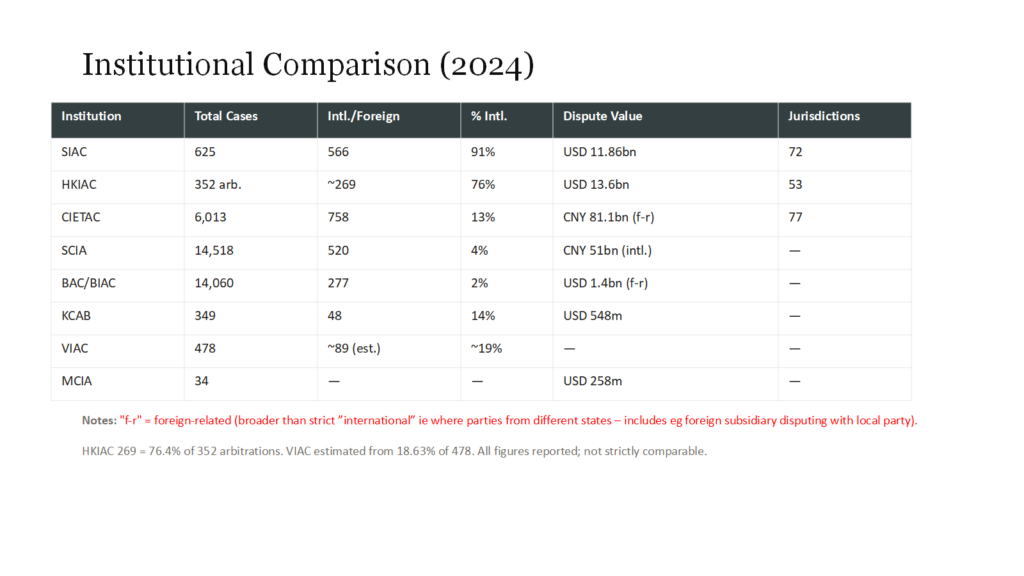
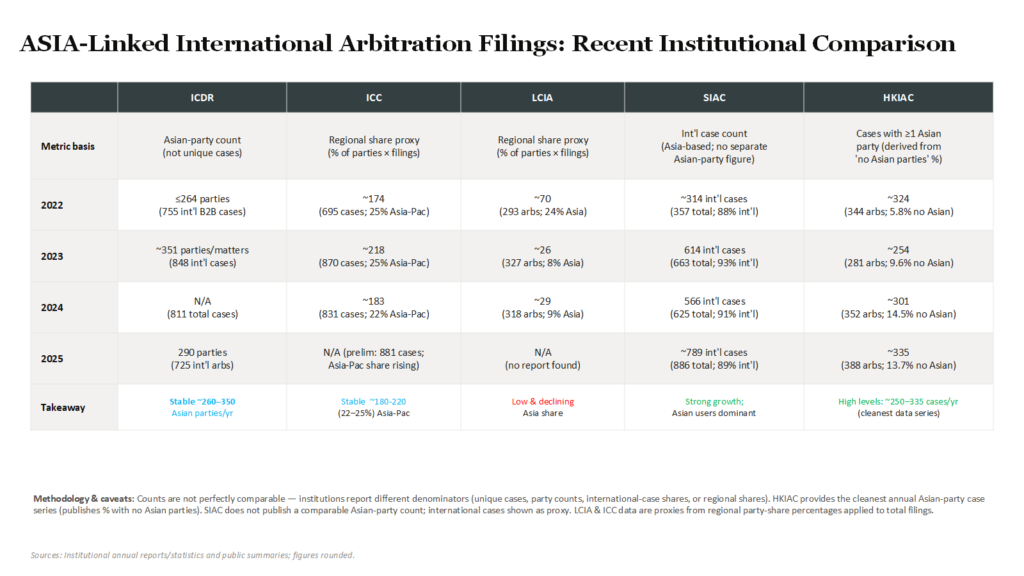
USyd Prof Vivienne Bath and I are writing a chapter on this (and Mediation) for the Oxford Handbook of International Trade Law in Asia (co-edited by Prof Julien Chaisse et al). Due to the tight word limit we move here some of our material, for readers interested in delving more deeply or widely into the topics compared to our published version. In particular, we delve deeper into the headline statistics on international commercial arbitration (ICA) case filings recorded across Asian institutions, especially in Singapore, compared say to Harvey AI which produced the summary Tables below: the first for Asia-based arbitral institutions, and the second adding Asia-related ICA case numbers for major non-Asian institutions:
- Introduction
Asia is a large and diverse region, with disparate systems of law and dispute settlement. These range from China’s socialist legal system with influences from across the world; the common law jurisdictions of India, Pakistan, Hong Kong, Singapore and Malaysia; and the civil law systems of Japan (with common law infusions), Korea, Thailand, Indonesia and others regionally. Each has its own history and features, reflecting local conditions. In the space available, it is not possible to discuss all of these jurisdictions.[1] This chapter looks mainly at international commercial arbitration (ICA) through major arbitral institutions particularly North and Southeast Asian Region, focusing on the three centres in the region which have had the most success in attracting arbitration case filings both regionally and internationally and in building international reputations: Singapore International Arbitration Centre (SIAC), Hong Kong International Centre (HKIAC) and China International Economic and Trade Arbitration Centre (CIETAC). It briefly discusses other developments in some other Asian centres, as well as ad hoc arbitration (especially in India) and international mediation.
ICA (as well as domestic arbitration, in some states) has grown strongly in Asia since the 1990s – especially over the last 15-20 years. This confounds some commentators who argued arbitration would not flourish due to “Asian values” favouring harmony and consensual dispute resolution (DR).[2] Yet there has been limited growth in international commercial mediation (and indeed domestic mediation for business disputes) from private suppliers of mediation services. This is despite some emergent government and institutional support in some Asian countries for mediation in cross-border commercial disputes, and many signings – albeit still not many ratifications – of the 2018 Singapore Mediation Convention.[3]
The chapter examines the relationship between the growth of arbitration and the functionality of domestic courts and wider civil justice systems; enforceability problems across the region; and the role of government as well as the courts in supporting ICA and mediation.
Overall development of Asian arbitration
Governments in Asia have increasingly shown an interest in encouraging ICA. With the exception of North Korea, almost all Asian nations are parties to the 1958 New York Convention on the Recognition and Enforcement of Foreign Arbitral Awards (NYC).[4] The enforcement regime for arbitral awards under the New York Convention offers substantial potential benefits over domestic court systems and the difficulties of enforcing foreign judgments.
To create a viable alternative DR forum for international commercial contracts, and to clarify the role of domestic courts in supervising arbitrations, many Asian nations also updated their arbitration statutes. Many adopted in some form, as a reputable international template, the United Nations Commission on International Commercial Arbitration (UNCITRAL) Model Law on ICA (ML).[5] Other states may be influenced by ML concepts and other international developments. China (discussed below) provides a good example.
In addition, many Asian nations (except notably India, Thailand and Vietnam) have acceded to the framework 1965 Washington Convention, assisting enforcement of investor-state dispute settlement (ISDS) arbitration through the International Centre for the Settlement of Investment Disputes (ICSID).[6] ISDS is briefly mentioned as it enhances familiarity with international arbitration generally, albeit sometimes generating controversy.[7] Most Asian nations (except Myanmar and Nepal) are also contracting parties to the Permanent Court of Arbitration, with Indonesia (2026) the most recent Asian nation to accede.[8]
There has also been substantial growth in the number of arbitral institutions across Asia offering ICA and/or quite often mediation services. Some have attracted significant number of ICA filings, but these may not be widely known. For example, the Vietnam International Arbitration Centre (VIAC) has recorded a considerable increase in arbitrations filed, especially over the last three years.[9] Yet the success of the numerous institutions around Asia in attracting ICA remains highly variable, with some very successful institutions (discussed below in more detail) and other institutions that have hardly attracted any international cases.
Overall, despite the lack of concrete region-wide statistics, it appears that there has been strong growth in ICA in the Asian region taken as a whole. Recent statistics published by the International Chamber of Commerce (ICC), for example, indicate substantial interest in ICA across Asia. Of the 881 cases filed under the ICC Arbitration Rules in 2025, 13.9 percent were from East and South Asia and the Pacific while 10.6 percent were from the Middle East and Central Asia.[10] Another Western-headquartered arbitration institution with a significant caseload involving Asian parties is the International Centre for Dispute Resolution (ICDR), created as a specialist division of American Arbitration Association in 1996. For example, it recorded 848 international cases filed in 2023, when about 351 Asian parties used ICDR services (174 from China and 32 from India, the second-largest group).[11]
Statistics published by individual Asia-based institutions also show mostly an increase in cases, albeit with some variability and exceptions.[12] However, care is needed (and exemplified below) when analysing reported ICA statistics. First, some centres (notably CIETAC and VIAC) adopt a broader definition of “international” when counting cases, extending beyond “truly” international cases where parties come from different states (the main ML definition) to encompass foreign related or “quasi-international” cases between a local company and an affiliate of a foreign company. Secondly, some institutions may count cases “handled”, including not only those administered under their own Rules, but also those under others like the UNCITRAL Arbitration Rules designed originally for ad hoc arbitration (so with the institution playing more limited roles), or even where the institution makes a default arbitrator appointment under background arbitration law (as with SIAC).
In addition to ad hoc arbitration, plus institutional arbitrations administered under ICC and ICDR Rules, three (more or less state-backed or supported) Asian institutions have been particularly successful, not just in the region but also for users outside Asia. According to the most recent well-regarded international arbitration survey by Queen Mary University of London with White & Case,[13] Singapore, Beijing and Hong Kong were all ranked globally in the top five seats for ICA, along with London (first) and Paris (fifth). Their arbitration rules were similarly ranked highly: third was SIAC, second was HKIAC and sixth was CIETAC, after ICC (first), the London Court of International Arbitration (LCIA, fourth) and the UNCITRAL Rules (fifth). While all three are in the top five most preferred arbitration rules by region (with the ICC and Shenzhen Court of International Arbitration or SCIA, in the Asia-Pacific), only Singapore (along with LCIA) has the distinction of being in the top five in all regions. HKIAC and SIAC have been particularly successful in attracting arbitrations from areas outside Hong Kong and Singapore. SIAC became very attractive to Indian parties. HKIAC has a strong international clientele, but is especially attractive to parties to China-related arbitrations. CIETAC, unsurprisingly, has been popular with Chinese parties.
[1] See generally eg Julien Chaisse and Luke Nottage (eds), International Investment Treaties and Arbitration Across Asia (Brill 2018); Michael J Moser (ed), Arbitration in Asia (2nd edn, JurisNet 2022); Raymond Leung, Asia Mediation Handbook (Sweet & Maxwell 2015); Shahla Ali and others (eds), New Frontiers in Asia-Pacific International Arbitration and Dispute Resolution (Kluwer Law International 2021); Nobumichi Teramura, Luke Nottage and Bruno Jetin (eds), Corruption and Illegality in Asian Investment Arbitration (Springer 2024) (open access) <https://link.springer.com/book/10.1007/978-981-99-9303-1> accessed 27 July 2026. [could consider cutting down this footnote if short of space LRN well we have to cut hugely especially eg Parts 1 and 2 anyway]
[2] cf generally Michael Pryles and Veronica Taylor, ‘The Cultures of Dispute Resolution in Asia’ in Michael Pryles (ed), Dispute Resolution in Asia (Kluwer Law International 1997) 1.
[3] United Nations Convention on International Settlement Agreements Resulting from Mediation (adopted 20 December 2018, entered into force 12 September 2020) (Singapore Convention on Mediation). See generally Nadja Alexander, Shouyu Chong and Vakho Giorgadze, The Singapore Convention on Mediation: A Commentary (2nd edn, Kluwer Law International 2022).
[4] Convention on the Recognition and Enforcement of Foreign Arbitral Awards (adopted 10 June 1958, entered into force 7 June 1959) 330 UNTS 3 (New York Convention); ratification status at <https://uncitral.un.org/en/texts/arbitration/conventions/foreign_arbitral_awards>.
[5] Adopters include Azerbaijan, Bangladesh, Bhutan, Brunei Darussalam, Cambodia, Hong Kong, Macao, India, Japan, Korea, Malaysia, Myanmar, the Philippines, Qatar, Singapore, Sri Lanka, Thailand and the UAE. The ML has not been adopted in Afghanistan, China, Indonesia, Kazakhstan, Lao PDR, Nepal, Taiwan or Vietnam. See UNCITRAL, UNCITRAL Model Law on International Commercial Arbitration (1985), with amendments as adopted in 2006; adoption status at <https://uncitral.un.org/en/texts/arbitration/modellaw/commercial_arbitration/status>.
[6] Convention on the Settlement of Investment Disputes between States and Nationals of Other States (adopted 18 March 1965, entered into force 14 October 1966) 575 UNTS 159 (ICSID Convention); ratification status at <https://icsid.worldbank.org/about/member-states/database-of-member-states> accessed 27 July 2026.
[7] Teramura, Nottage and Jetin (n 1); Luke Nottage, ‘Evolving Antipodean, Asian and European Ambivalence Around ISDS Arbitration: A Compromise Way Forward?’ (2026) 34 Griffith Law Review (forthcoming).
[8] Permanent Court of Arbitration, ‘Contracting Parties’ <https://pca-cpa.org/en/about/introduction/contracting-parties/> accessed 7 July 2026.
[9] Vietnam International Arbitration Centre, ‘Statistics on Dispute Resolution Activities in 2025’ <https://viac.vn/en/statistics/statistics-on-dispute-resolution-activities-in-2025-s49.html> accessed 27 July 2026. Although almost half of the 532 cases filed in 2025 were foreign-related, this may include foreign invested enterprises in Vietnam rather than foreign parties.
[10] International Chamber of Commerce, ‘ICC Dispute Resolution 2025’ <https://www.iccwbo.org> accessed 9 August 2026.
[11] See <https://www.faegredrinker.com/en/insights/publications/2024/9/icdr-jams-scc-and-hkiac-release-caseload-statistics-for-2023> and <https://www.reedsmith.com/articles/icdrs-strategic-vision-for-asia/>, accessed 13 August 2026.
[12] Each institution has its own way of setting out statistics, particularly in relation to the question of what constitutes a foreign or international case.
[13] White & Case and Queen Mary University of London, ‘2025 International Arbitration Survey: The Path Forward: Realities and Opportunities in Arbitration’ (2025) <https://www.qmul.ac.uk/arbitration/media/arbitration/docs/White-Case-QMUL-2025-International-Arbitration-Survey-report.pdf> accessed 22 June 2026, charts 3, 4 and 5.
Singapore and SIAC
To bolster cross-border investment and trade, Singapore was quite quick within Asia to ratify the NYC, in 1986. After the ML was agreed in 1985, Singapore also adopted that as the template for its International Arbitration Act 1994. For domestic arbitrations, Singapore replaced its remaining arbitration statute based on English law with the ML-based Arbitration Act in 2001. It has not integrated the two statutes into one, as is the case in Hong Kong. Nor has Singapore (unlike Hong Kong) adopted the 2006 ML amendments – although a 2009 amendment to the International Arbitration Act does allow enforcement of (local and foreign-seated) arbitrators’ interim measures orders.
Singapore also still shows some deference to English case law in some respects, where the ML is unclear or has gaps. Notably, its courts maintain a complex multi-step approach to determine the law applicable to the arbitration agreement when the parties have not expressly agreed on this.[1]
Overall, partly because Singapore adopted the ML later than HK, case law was less internationalist in applying its international arbitration legislation. However, 2001 and 2002 the legislature promptly amended its Act following judgments addressing implied opting out of the ML regime from parties’ choice of Rules, which were unhelpful in promoting Singapore as a seat.[2] Singaporean judgments subsequently became arguably as internationalist as Hong Kong’s judgments. This pattern can be seen for example in substantial deference by Singaporean courts to the procedural decisions of arbitrators,[3] although they still intervene in egregious cases.[4]
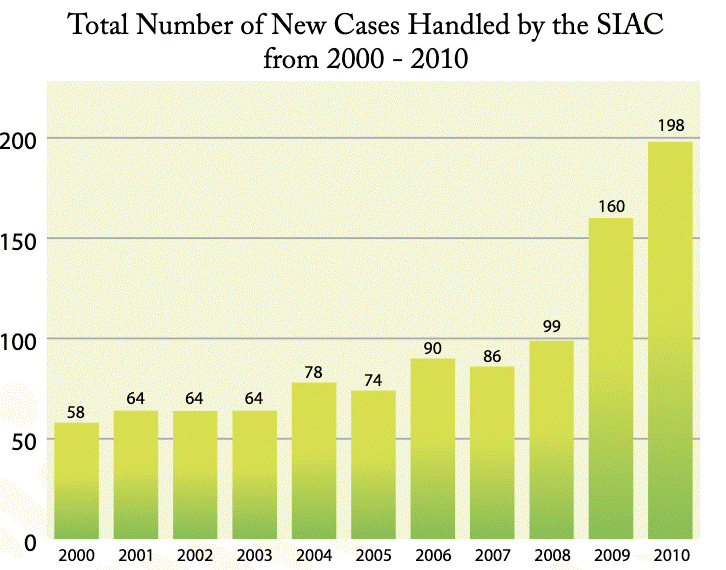
The Singaporean government and judiciary promoted ADR from the 1980s primarily to address delays in civil litigation, focusing on mediation,[5] but it also encouraged establishment of SIAC in 1991. SIAC already then introduced its first set of standalone Arbitration Rules, with the most recent (7th) edition published in 2025 after extensive public consultation. However its caseload only grew slowly through to 2008, when it reached 99 cases filed, before jumping to 160 in 2009 and 198 in 2010:[6]
By 2019 there were 479 cases handled (87% international), including 25 cases (5% of [2] [3] [4] [5] the total) limited to making default appointments of arbitrators in otherwise ad hoc proceedings.[7] The latter arises through parties’ prior agreement to this restricted role for SIAC, eg by specifying it as the appointing authority but otherwise arbitrating under UNCITRAL Rules, or in purely ad hoc proceedings with no agreed Rules but with SIAC as default appointing authority under the 1994 Act. The 2019 Annual Report implies that from 2009, where the proportion of default appointments for ad hoc proceedings was 17.5% (28 out of 160 total cases handled), the proportion declined more or less consistently to 6.7% by 2018.
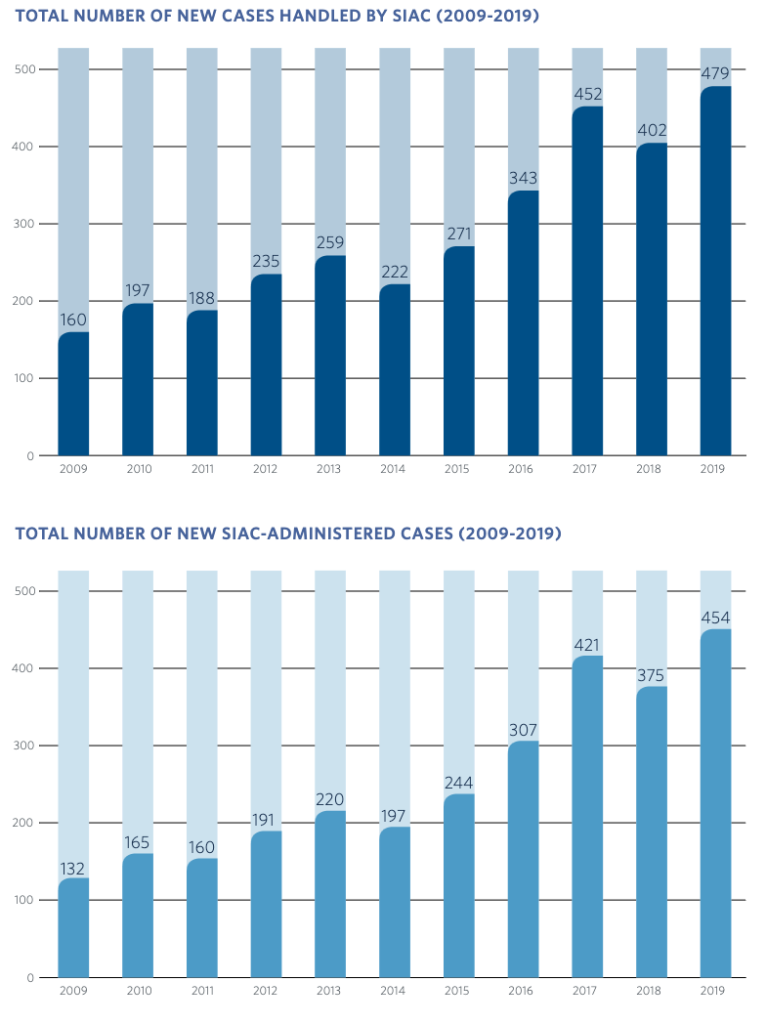
This decline continued from 2019 into the 2020s (excluding an anomaly in 2025), showing SIAC’s evolution into a full-service institutional arbitration provider and the broader global trend favouring institutional over ad hoc arbitration. Thus, in 2021 SIAC recorded handling 469 cases, with 5% being only default appointments.[8] Yet in 2025 SIAC handled 866 cases (89% international), but this included 149 default appointments (a remarkable 17% of the total) – so cases involving full administration by SIAC (under its Rules) comprised only 717 cases, both domestic and international.[9]
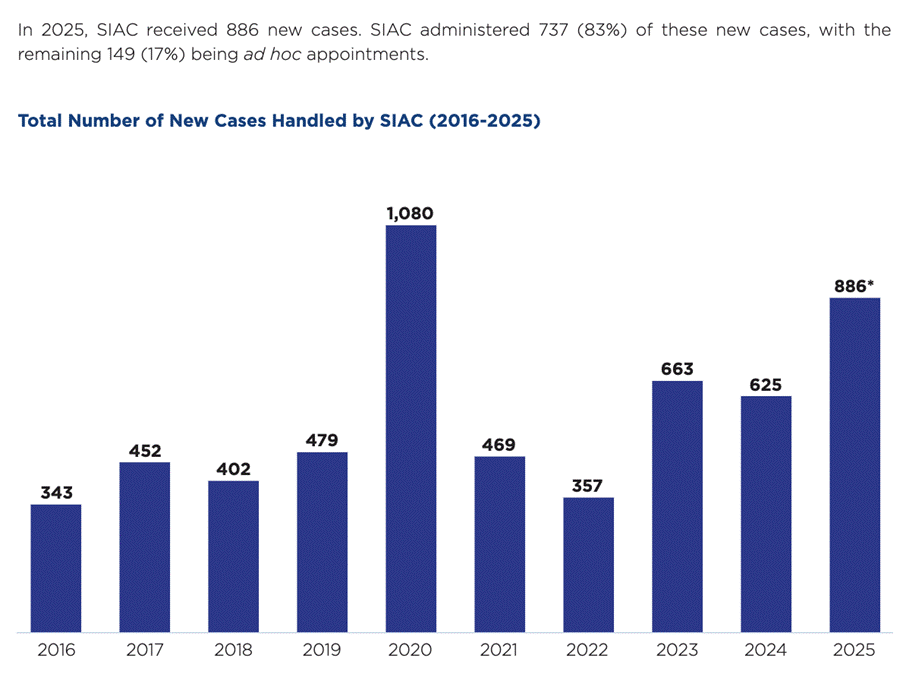
However, it seems that that 135 of the 149 default appointments were in “related cases”[10] (though counted separately), which likely explains this significant jump. Somewhat similarly, SIAC had declared a record 1080 cases for 2020, yet the numbers of all arbitrators appointed (almost all for cases under its own Rules) remained similar to 2019 – one commentator adds this suggested:[11] “a smaller number of arbitrations than appears on the face as SIAC allows arbitrations under associated contracts to be commenced in a single notice of arbitration (for the purpose of the case statistics these count as multiple cases)”.
Indeed, as mentioned above, the annual new cases handled by SIAC dropped down again to 469 in 2021 (similar to 2019), before resuming steady growth through to 866 cases in 2025 (although only 717 fully administered).
SIAC’s significant step up in cases filed over 2009-10 was likely assisted by a delayed impact from disputes arising from the 2007 Global Financial Crisis, since other international arbitration institutions (including HKIAC) also saw an increase around that time. But SIAC also benefited by the inauguration of Maxwell Chambers in 2010 (and greatly expanded in 2019, unveiled the day after the signing ceremony for the Singapore Mediation Convention). [1] The government contributed significantly to the refurbishment of this public property, with state-of-the-art hearing rooms and office space not only for smaller practitioners and SIAC but other arbitral organisations.
In addition, SIAC’s third edition Rules (2007) started shifting away from the UNCITRAL Rules core characterising the first (1991) and second (1997) editions.[2] This accelerated with the 2010 Rules (fourth edition), adding innovative Emergency Arbitrator and Expedited Arbitration procedures. Notably also from 2007, to encourage efficiency by arbitrators SIAC moved from the traditional LCIA (and still HKIAC) remuneration on an hourly rate, to fees based on dispute amount (as in the ICC).
The SIAC 2013 Rules (fifth edition) were also noteworthy by adopting a new structure for governance. It created the SIAC Court of Arbitration, modelled on the ICC Court and LCIA Court. The Court was to decide challenges to arbitrators and objections to SIAC’s prima facie jurisdiction, determine matters of arbitration policy, and oversee case administration and SIAC Secretariat work. The SIAC Board of Directors was refocused on business operations, marketing and development, and corporate governance. Dr Michael Pryles from Australia, appointed Chairman of the Board from 2009, became the founding President of the SIAC Court. That also comprised 16 leading arbitration practitioners from many jurisdictions,[3] mimicking the ICC Court’s multinational character to give SIAC credibility as a truly global institution. This was reinforced by appointing as President, from the USA, Gary Born from 2015 and Lucy Reed from 2021.
[1]See S Jayakumar, ‘Speech at the Grand Opening of Maxwell Chambers’ (Singapore, 21 January 2010) <https://www.nas.gov.sg/archivesonline/data/pdfdoc/20100806001.htm> accessed 27 July 2026 (mentioning PCA, ICC-ICA, WIPO AMC and ICSID committed as tenants); interview with Philip Jeyaretnam (Chairman, Maxwell Chambers), Asia Business Law Journal <https://law.asia/maxwell-chambers-arbitration-evolution/> accessed 27 July 2026 [Luke/Vivienne to add article title and date].
[2] See SIAC, ‘Administered Arbitration’ <https://siac.org.sg/administered-arbitration> and generally John Choong, Mark Mangan and Nicholas Lingard, A Guide to the SIAC Arbitration Rules (2nd edn, Oxford University Press 2018).
[3] Including Bahrain, Belgium, China, France, India, Japan, Singapore, UK and USA: Shaun Lee, ‘Changes at the SIAC: New Rules, New Structure, New Members’ (Singapore International Arbitration Blog, 2 April 2013) <https://singaporeinternationalarbitration.wordpress.com/2013/04/02/changes-at-the-siac-new-rules-new-structure-new-members/> accessed 27 July 2026.
Since the 2010 and 2013 SIAC Rules (from the 4th and 5th editions onward), draft awards are submitted to the Registrar (heading the Secretariat) who may suggest modifications as to the form, similarly to the ICC. Such developments helped SIAC to market itself also as a high-quality institution (with commensurate administration fees), to attract cases and bolster cross-border enforceability prospects. Singapore Courts provided assistance by upholding in 2010 an earlier arbitration agreement providing for ICC Rules arbitration administered by SIAC, indicating for example that the SIAC then Board could perform some of the ICC Court functions.[12]
The SIAC Rules 2016 (sixth edition) kept attracting attention through innovations such as a procedure for early dismissal of claims manifestly without legal merit (adapted from ICSID Arbitration Rules), along with expanded provisions for multiple contracts, consolidation and joinder (reflecting the increasing complexity of arbitrations being filed – although such patterns are also found in HKIAC and other arbitral centres). The 2025 SIAC Rules expanded significantly in length, notably adding introducing ex parte emergency relief (protective preliminary orders) and a Streamlined Procedure for smaller claims than under the Expedited Procedure track).
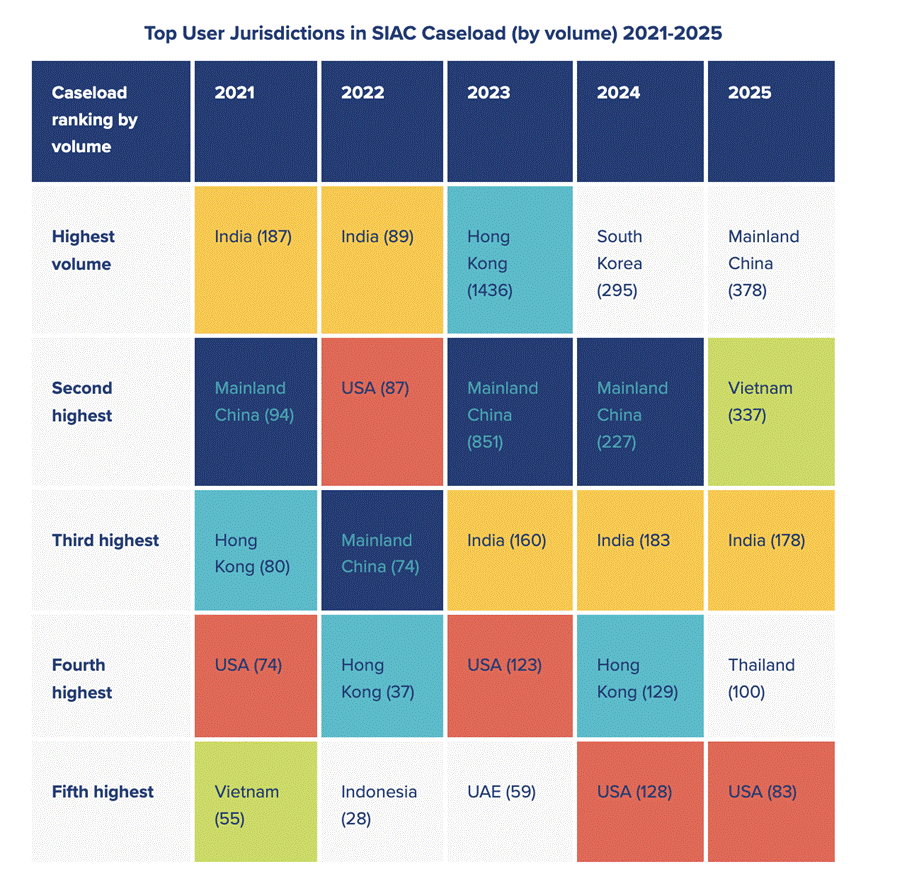
SIAC also benefited from the growth of intra-Asian trade and investment, especially the rise of India, where it enjoyed a significant advantage over Hong Kong and China. The latter were only gazetted under Indian law for enforcement of their awards in 2012, whereas Singapore was in a first group of gazetted countries dating back to India’s Foreign Awards (Recognition and Enforcement) Act 1961.[13] Indian parties therefore began arbitrating extensively in Singapore, which marketed itself heavily in India – setting up two offices there from 2013.[14] However in recent years the proportion of Indian cases in SIAC has dropped (by numbers) relative to those involving China and Hong Kong.[15]
SIAC further introduced Investment Arbitration Rules in 2017. However, SIAC does not report any case applying them, despite having “administered investment disputes under standard SIAC Rules and … served as the appointing authority in investment disputes under the UNCITRAL Arbitration Rules”.[16] This is not too unexpected as the usual way nowadays for investment arbitration rules to apply in ISDS is through being provided as an option for foreign investors under investment treaties, sometimes dating back decades; and those currently overwhelmingly list ICSID and/or UNCITRAL Rules. SIAC’s Rules however can be marketed more now that Singaporean courts have developed significant experience in dealing with ISDS cases.[17]
The Singapore Chamber of Maritime Arbitration (SCMA) was established in 2004 under SIAC management. However, especially after feedback that the maritime community preferred a non-administered, ad hoc-style model rather than the fully administered institutional model that SIAC was increasingly adopting, SCMA —reconstituted in May 2009 as an independent organisation. It adopts a “light touch” self-administered model, deliberately modeled on the London Maritime Arbitrators Association (LMAA) rather than on administered institutions like the ICC or SIAC.
It has seen some significant growth, from over 100 cases during 2009-11 (combined with SIAC[18]), 43 just in SCMA in 2020, and 95 in 2024. Over 50% of parties involved in SCMA disputes are not Singapore-based. Singapore’s overall share of global maritime arbitration has grown from approximately 5% of London’s volume in 2022 to 9% in 2024. The recent surge has been attributed in part to the global trade war, which has generated increased shipping and trade disputes in the Asia-Pacific region.[19]
[1] Anupam Mittal v Westbridge Ventures II Investment Holdings [2023] SGCA 1. Along that line, see also Singapore International Dispute Resolution Academy (SIDRA), Review of the Singapore International Arbitration Act (November 2024) <https://sidra.smu.edu.sg/sites/sidra.smu.edu.sg/files/2025-03/Review%20of%20the%20Singapore%20International%20Arbitration%20Act%20(2024)_final.pdf> accessed 27 July 2026.
[2] Mohan Pillay, ‘The Singapore Arbitration Regime and the UNCITRAL Model Law’ (2004) 20(4) Arbitration International 355. By contrast, a revision to Australia’s International Arbitration Act came only in 2010, by preventing opting out altogether (s 21) to counteract similarly unhelpful case law.
[3] Luke Nottage, ‘Deference from National Courts to Tribunals on Issues of Procedure at the Post-Award Stage’ in Franco Ferrari and Friedrich Rosenfeld (eds), Deference in International Commercial Arbitration: The Shared System of Control in International Commercial Arbitration (Kluwer Law International 2023).
[4] Eg BZV v BZW [2022] SGCA 1 (setting aside a SIAC award found ‘manifestly incoherent’) and DJO v DJP[2024] SGHC(I) 24, upheld in DJP v DJO [2025] SGCA(I) 2(setting aside upheld on appeal, where a SIAC award was tainted by the tribunal – including former Chief Justice of India Dipak Misra – self-plagiarising from an award rendered in India arising from the same project).
[5] Eugene Tan, ‘Harmony as Ideology, Culture, and Control: Alternative Dispute Resolution in Singapore’ (2007) 9(1) Australian Journal of Asian Law 120.
[6] SIAC, ‘CEO Annual Report 2010’ 3 (the first available via <https://siac.org.sg/annual-reports> accessed 27 July 2026). This and other early Annual Reports do not specify the proportions of international cases, but this may have been lower than the proportions that later started being annually reported (over 85%).
[7] SIAC, ‘Annual Report 2019’ 14–15 <https://siac.org.sg/wp-content/uploads/2022/06/SIAC-AR_FA-Final-Online-30-June-2020.pdf>.
[8] SIAC, ‘Annual Report 2021’ 17 <https://siac.org.sg/wp-content/uploads/2022/06/SIAC-AR2021-FinalFA.pdf>.
[9] SIAC, ‘Annual Report 2025’ 26–27 <https://siac.org.sg/wp-content/uploads/2025/09/SIAC-Annual-Report-2025.pdf>. The Annual Report does not break down the proportion of international cases for this subset of 717 cases; it may be more or less than the 89% recorded for the total 866 cases.
[10] Herbert Smith Freehills Kramer, ‘SIAC Annual Report 2025: Key Statistics, Trends and Takeaways for International Arbitration’ (2026) <https://www.hsfkramer.com/notes/arbitration/2026-5/siac-annual-report-2025-key-statistics-trends-takeaways-for-international-arbitration> accessed 27 July 2026.
[11] Amanda Lees, ‘SIAC Statistics: Looking Behind the Large Increase in SIAC Caseload’ (Mallesons Pulse, 29 April 2021) <https://pulse.mallesons.com/international-arbitration/siac-statistics-looking-behind-the-large-increase-in-siac-caseload> accessed 27 July 2026 – adding as other possible explanations for this anomalous spike in 2020: ‘a large number of cases in which the tribunal is yet to be appointed due to delay by the parties in paying their deposits … and arbitrations being commenced for limitation or settlement purposes only and then stayed’.
[12] Eg Insigma Technology Co Ltd v Alstom Technology Ltd [2009] SGCA 24, [2009] 3 SLR(R) 936; see also Richard Hill, ‘Hybrid ICC/SIAC Arbitration Clause Upheld in Singapore’ (Kluwer Arbitration Blog, 10 June 2009) <https://legalblogs.wolterskluwer.com/arbitration-blog/hybrid-iccsiac-arbitration-clause-upheld-in-singapore/> accessed 27 July 2026.
[13] Michelle Bradfield and Daniel Harrison, ‘India to Recognise and Enforce Arbitral Awards from China’ (Lexology, 1 October 2012) https://www.lexology.com/library/detail.aspx?g=f817c2a2-6f53-4c62-afb0-22545a790fc8 accessed 27 July 202; Government of India, Ministry of Law and Justice, Notification SO 2252(E), Gazette of India, Extraordinary, pt II, s 3(ii) (23 September 2008); Ritin Rai, ‘India’ in International Chamber of Commerce, ICC Guide to National Procedures for Recognition and Enforcement of Awards under the New York Convention (2019) https://jusmundi.com/en/document/publication/en-india-9 accessed 27 July 2026.
[14] By 2013 (when 21% of SIAC’s caseload was still maritime/shipping), for 259 cases handled there were 85 Indian parties. SIAC, ‘Annual Report 2013’ 7 <https://siac.org.sg/wp-content/uploads/2022/06/SIAC_Annual_Report_2013-1.pdf>.
[15] ibid; Herbert Smith Freehills Kramer (op cit).
[16] Aceris Law, ‘Singapore International Arbitration Centre FAQ’ 3 <https://www.acerislaw.com/wp-content/uploads/2021/03/Singapore-International-Arbitration-Centre-FAQ.pdf>.
[17] See eg the Sanum v Laos dispute, discussed in Romesh Weeramantry and Uma Sharma, ‘Corruption and Investment Arbitration in the Lao People’s Democratic Republic: Corruptio Incognito’ in Teramura, Nottage and Jetin (n 1) 311 <https://link.springer.com/chapter/10.1007/978-981-99-9303-1_12>.
[18] Maritime/shipping has consistently been a major SIAC dispute category and still represented 10% of its 2025 caseload (85 cases): SIAC, ‘Annual Report 2025’ (op cit) 32.
[19] Sarah Wong, “Global Trade Law Propels Singapore’s Surge as Maritime Arbitration Hub” Asian Legal Business (25 November 2025) <https://www.legalbusinessonline.com/features/print-issue-global-trade-war-propels-singapore%E2%80%99s-surge-maritime-arbitration-hub> accessed 14 August 2026.
